


Claims leakage rarely announces itself. It accumulates quietly, in files that close a little too quickly, in recoveries that were available but never pursued, and in referrals that arrive long after the trail has gone cold. For most property and casualty carriers, the largest controllable portion of that leakage sits in subrogation management.
Subrogation alone costs insurers an estimated $15 billion each year in opportunities that are never identified or pursued, according to the NAIC. That shortfall sits against a process already returning real money; the NAIC also found that US insurers recovered nearly $51.6 billion through salvage and subrogation across the auto physical damage, commercial auto liability, and personal auto liability lines in 2021 alone.
The same study found that roughly one in four property liability insurers don’t recover any salvage or subrogation in a given year. Among carriers that do recover, the variation is dramatic: Those in the top quintile recover more than 20% of net claims paid, while those in the bottom quintile recover about half a percent.
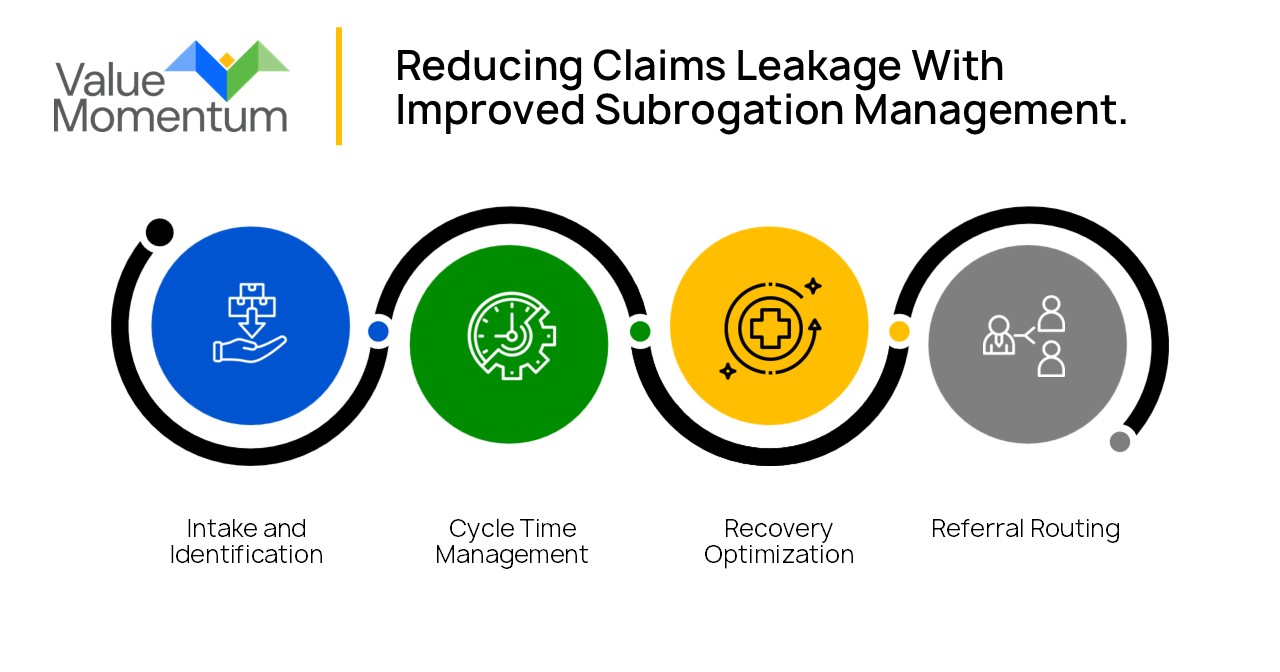
4 Areas Where Subrogation Management Reduces Leakage
Recovery is getting structurally harder. The Insurance Research Council found that 33.4% of U.S. drivers were either uninsured or underinsured in 2023, a 10 percentage point increase in the combined rate since 2017. When the at-fault party carries no coverage or limits well below the value of the loss, the recovery available to a carrier shrinks or disappears entirely, regardless of how strong its liability position is.
As the pool of fully recoverable claims narrows, the claims that do carry viable recovery potential become proportionally more valuable — and failing to identify them becomes proportionally more expensive. Carriers cannot control how many at-fault drivers carry adequate limits. But they can control whether their own process finds and pursues the recoveries that remain.
Our ValueMomentum team helped a Fortune 500 insurer do just this by incorporating machine learning into its subrogation process for a modern, data-driven approach to recovery. Below are four critical areas of subrogation management we helped the client modernize to drive real business benefits:
1. Intake and Identification
Recovery potential is highest at the moment a claim enters the system; it declines steadily from there. Evidence deteriorates, witnesses become harder to reach, and the responsible party’s insurer builds its own position. A subrogation opportunity flagged three weeks into a file is worth measurably less than the same opportunity flagged on day one.
Our Fortune 500 insurer client focused on addressing this constraint at the structural level. Its original predictive models operated independently of the claims system, transferring results to claims supervisors after the fact. Deriving insights and acting on them could take a month or more. Without direct access to analytics in the workflow, adjusters also risked generating unnecessary work by pursuing false positives. The carrier rebuilt identification around a real-time predictive model integrated directly with its claims platform, scoring recovery likelihood at first notice of loss (FNOL) rather than reporting on it weeks later.
2. Cycle Time Management
Carriers commonly measure subrogation by total dollars recovered, which leaves a second dimension unmanaged. NAIC research found that only about 28% of total recovery on personal auto liability claims occurs in the year the loss is incurred, and roughly 35% for commercial auto liability; cumulative recovery reaches only about 76% by the end of the third year. Recovery that arrives three years after the loss is worth less than the same recovery collected in the first 12 months.
Managing cycle time means tracking aging across the recovery portfolio, escalating files that stall, and treating time to recovery as a performance measure alongside total dollars. For our Fortune 500 client, embedding identification in the workflow cut overall recovery cycle time by 9%, compressing the window between a loss and the money coming back.
3. Recovery Optimization
Once a file is flagged, decisions about when to pursue settlement, which counterparty position to take, and whether to move toward alternative dispute resolution or litigation determine how much of the available recovery a carrier actually collects. Analytics sharpen each of those calls. Jurisdiction-specific liability patterns, insight into the adverse carrier’s settlement behavior, and win-probability modeling give handlers a basis for negotiation beyond experience alone, while settlement-timing prediction indicates when a file is likely to yield its best outcome.
Precision matters as much as reach here. The Fortune 500 insurer’s previous process left adjusters exposed to false positives, generating work on files with little genuine recovery potential. Scoring both the likelihood and the value of recovery changed what handlers spent their time on, concentrating effort on the opportunities that justified it and improving the efficiency of adjuster reviews across the operation.
4. Referral Routing
NAIC research also found that carriers writing a greater proportion of their premiums in a given line recover a larger share of their total in the first year for that line. Depth of experience translates into better process, sharper judgment on liability, and more effective negotiation. It’s unlikely that every claim handler can specialize in every claim type, but insurers can ensure that complex recovery opportunities are routed to the handlers best equipped to work them.
Our Fortune 500 insurer client was able to automate nearly 20% of its subrogation referrals, and the results separated sharply along that line. Auto-referred opportunities recovered losses at a 12% higher rate and showed a 6% greater likelihood of recovery than manually referred claims. The same claims organization, working the same book, produced materially better outcomes on files the model surfaced.
This carrier saw measurable results from investing in an analytics-driven subrogation process, and this is not an isolated occurrence. Carriers that build subrogation identification into the front end of the claims process, rather than treating it as an afterthought, have seen recovery uplift in the range of 15-25%, in ValueMomentum’s experience.
Turning Recovery Into a Discipline
Improving subrogation management means changing recovery from a downstream cleanup function into an operating discipline. Every dollar recovered through subrogation comes directly off incurred loss. Few levers available to a claims organization act that directly on the loss ratio, and fewer still are as consistently underused.
Modernizing the components of subrogation management — intake and identification, cycle time management, recovery optimization, and referral routing — can help insurers drive measurable results that directly improve their claims leakage.
To learn more about the technical approach and integration model behind the results above, read the full case study “Fortune 500 Insurer Optimizes Subrogation Recovery With Predictive Modeling.”