


Indemnity leakage is quietly eroding underwriting profitability across the property and casualty (P&C) industry. As litigation costs climb and claims grow more complex, carriers are discovering that the primary threat to their loss ratios is not the frequency of claims, but the compounding severity of exposures.
According to a 2026 CLM Litigation Management Study, defense counsel legal fees and indemnity costs have risen for six consecutive years. Auto and trucking has overtaken general liability as the line of business most cited as carriers’ single largest litigation spend driver — now named by 33.3% of study participants, up from 24% in 2023. Compounding the pressure, 85.2% of carriers report an increase in the frequency of policy limit demands over the past three years.
Furthermore, data from Marathon Strategies reveals that social inflation has driven nuclear verdicts against corporate defendants to historic levels, recording 135 major verdicts totaling $31.3 billion, with a median verdict of $51 million. For insurers, the window to intervene is narrow. Operational corrections must occur before a file’s economic trajectory hardens into a loss ratio deficit.
Controlling Claims Leakage Before Loss Ratio Deterioration
Claims leaders are increasingly reporting that unmanaged files systematically attract overpayments. Settlement-phase leakage remains among the largest sources of controllable loss across the claim life cycle. Evolving plaintiff-bar strategies, aggressive legal advertising, and sophisticated third-party litigation funding mean a claim left unchecked at intake behaves fundamentally differently than one steered dynamically from day one.
That’s where what we refer to as “severity conservation” comes in. Severity conservation requires identifying operational leakage points at their source. By intercepting severe exposures before they mature into protracted litigation, carriers can stabilize technical results. This structural protection rests on four foundational operational pillars:
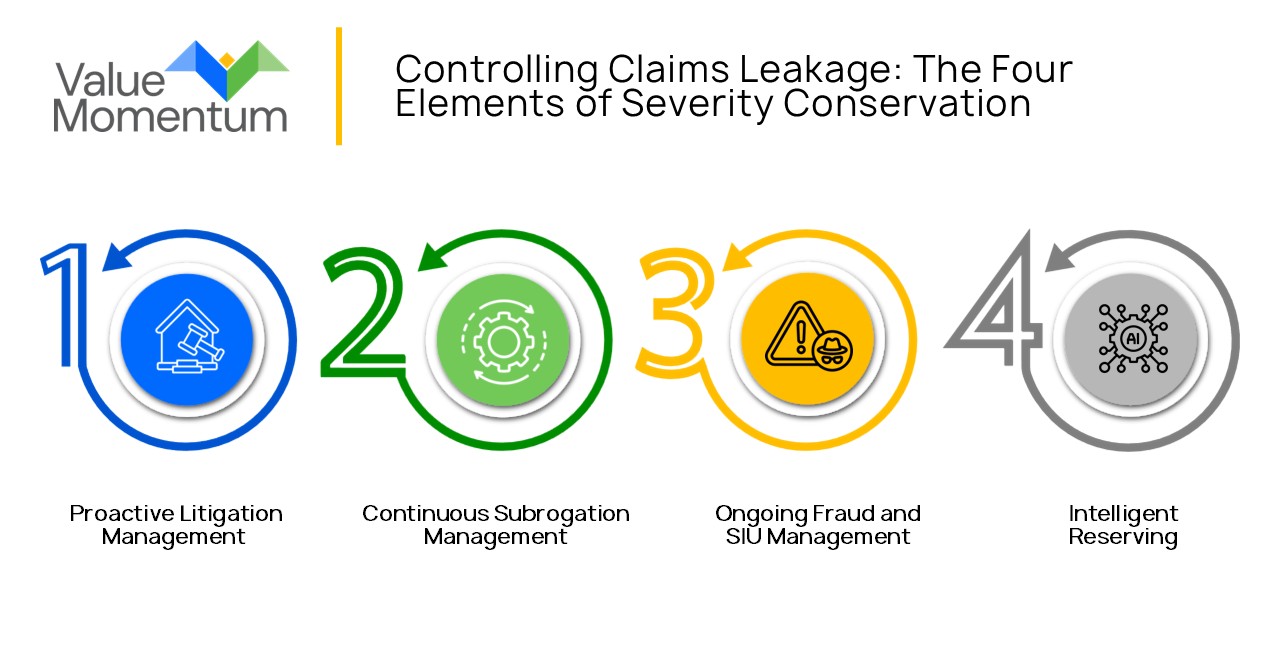
1. Proactive Litigation Management
Litigation is the primary severity multiplier in a claim file. Data from the 2026 CLM Study shows that while 87% of non-workers’-comp litigated claims ultimately settle (a sign of strong overall settlement quality), the administrative and defense spend required to close them continues to compress margins, even as only 3% of cases proceed to a formal verdict.
Proactive litigation management relies on scoring litigation propensity at first notice of loss (FNOL), optimizing attorney selection and panel performance, deploying suit-avoidance and early resolution playbooks, and applying venue-severity intelligence that accounts for jurisdictional variation in verdict behavior.
In our diagnostic work, claims organizations implementing predictive intake scoring have typically seen litigation frequency reductions in the 12–18% range (~15% midpoint, results depend on data maturity and claim mix), concentrated in auto liability and general liability lines. Routing complex files to specialized resources early preserves flexible, less expensive resolution pathways before costs compound.
2. Continuous Subrogation Management
Subrogation is a direct, and frequently underutilized, counterweight to indemnity severity. NAIC data shows U.S. insurers recovered $51.6 billion through subrogation in 2021 alone, yet industry estimates suggest another $15 billion in missed opportunities goes uncaptured annually.
Continuous or ongoing subrogation management centers on deploying recovery-likelihood scoring at FNOL, automated triage to subrogation specialists, and active portfolio tracking and aging management, paired with recovery optimization and settlement analytics.
Carriers that build subrogation identification into the front end of the claims process rather than treating it as an afterthought have seen recovery uplift in the range of 15% to 25%, in our experience. Every dollar recovered through subrogation is a dollar removed directly from incurred loss, making this one of the most direct levers available for severity conservation.
3. Ongoing Fraud and SIU Management
Sophisticated fraud patterns and medical abuse inflate claim severity in ways that adjuster-dependent referral alone misses. Modern fraud and Special Investigation Unit (SIU) management combines 0-100 fraud complexity scoring at FNOL with network link analysis for SIU workbenches, continuous case monitoring and escalation, and iterative model improvement as fraud patterns evolve.
Shifting from reactive, post-facto referrals to continuous, analytics-driven screening helps claims organizations keep pace with coordinated fraud rings and exaggerated medical billing. In our experience and across industries, incorporating AI-powered fraud capabilities earlier into critical processes has improved fraud detection rates by an average 20%.
As fraud tactics grow more sophisticated, particularly in coordination with aggressive litigation funding and legal advertising, continuous model refinement becomes essential to keeping pace.
4. Intelligent Reserving
Reserve inaccuracy does more than distort financial reporting; it amplifies the risk associated with every claim left open. Tail risk compounds when reserves fail to reflect the true trajectory of a claim, and reserve volatility undermines the actuarial discipline carriers depend on for accurate loss forecasting.
Intelligent reserving addresses this through reserve accuracy scoring by claim segment, tail factor calibration by line of business and jurisdiction, stair-stepping detection paired with workflow escalation, and actuarially defensible reserve range modeling.
The result is a shared, calibrated view of ultimate exposure. One that closes the persistent gap between initial reserve estimates and eventual settlement outcomes and reduces friction between claims and finance functions.
Individually, each of these levers reduces a specific point of claims leakage, but their real value emerges when carriers apply them together, as parts of a single, coordinated approach to severity.
The Measurement Gap Behind Severity Conservation
Most carriers already believe they have a reasonable handle on where their leakage lives; that belief is worth stress-testing.
The same CLM Litigation Management Study that documents rising litigation spend also identifies a quieter, more structural problem: over 96% of defense counsel say they would be willing to share detailed billing and case data with carriers, yet 97% report that carriers simply don’t ask. The information needed to identify where severity is being mismanaged already exists inside law firm systems, claim files, and adjuster notes. What is missing is a consistent mechanism for pulling it into view before it hardens into a loss ratio outcome.
This is a recurring pattern across the industry: a persistent gap between how claims organizations believe they are performing and what an independent evaluation reveals. Self-assessments tend to underestimate leakage because the metrics most commonly tracked (cycle time, closure rate, adjuster caseload, etc.) were never designed to identify severity drivers like venue risk concentration, missed subrogation windows, or attorney panel underperformance. Those drivers require a different kind of measurement, applied at the file level, before the metrics that matter get rolled up into a portfolio view that hides them.
Severity conservation, in other words, is as much a measurement discipline as it is an operational one. Carriers that treat it that way, establishing an independent, recurring view of where leakage originates rather than relying solely on internal reporting, tend to find that the biggest opportunities are not the ones already on their dashboards.
Expanding the Horizon: From Leakage Detection to Systemic Severity Conservation
Identifying leakage points across the four foundational pillars is critical, but the real differentiator for modern carriers lies in moving from reactive detection to continuous, coordinated orchestration. Treating litigation, subrogation, fraud, and reserving as isolated, sequential steps in a claim’s life cycle leaves gaps between them, and leakage tends to accumulate precisely in those gaps. True severity conservation requires an interconnected framework that operates continuously from first notice of loss through final settlement, rather than four disconnected checkpoints.
As social inflation, nuclear verdicts, and industry-wide talent shortages compound, a file’s economic trajectory hardens faster than it used to. Bridging the operational disconnects that let leakage quietly accumulate has become less optional and more urgent.
Three operational shifts stand out as the difference between a standard claims operation and one built for this environment:
- Unified intake and predictive triage. Scoring a claim simultaneously for litigation propensity, subrogation potential, and fraud complexity at FNOL, rather than waiting for an adjuster to flag it manually weeks into the process, means complex exposures get routed to the right resources on day one, not after the resolution window has narrowed.
- Closing the law firm data gap. As the measurement gap above illustrates, much of the data needed to manage severity already exists in defense counsel systems, it’s rarely requested in a structured way. Turning routine legal updates into structured venue-severity intelligence gives carriers a real basis for optimizing panel performance and deploying early-resolution playbooks before legal spend compresses margins further.
- Continuous, analytics-driven screening. Static, adjuster-dependent referral models struggle to keep pace with fraud patterns and litigation tactics that evolve in real time. Continuous file monitoring with automated escalation catches shifting claim dynamics as they happen, rather than during a post-facto audit months later.
Reimagining claims execution through this lens does more than stabilize technical results, it produces measurable financial outcomes. In our diagnostic work, streamlining workflows and applying disciplined claims-handling evaluation has typically reduced loss adjustment expense by 10% to 12%, while intercepting severe exposures earlier and driving greater process predictability has trimmed pure indemnity leakage by 4% to 6%.
Bringing the Four Elements Together
No single lever fully controls severity on its own. Litigation management reduces the likelihood that a claim escalates. Subrogation management recovers value that would otherwise be lost. Fraud and SIU management prevent inflated payouts from advancing unchecked. And intelligent reserving ensures that any remaining severity is measured accurately.
Together, these four elements form a diagnostic-led framework for protecting every dollar of indemnity before it reaches the loss ratio, rather than reacting to claims leakage after the fact. Social inflation, nuclear verdicts, and increasingly sophisticated litigation funding are not trends carriers can wait out. They require a deliberate, data-driven response built into the claims execution model.
For claims leaders, the starting point isn’t a new tool, it’s an honest answer to a simple question: if an independent reviewer opened twenty of your open files today, would they find the same picture your dashboards show? For most organizations, the answer reveals more about where to focus than another fiscal quarter of internal reporting ever will.
To explore how social inflation is compounding these severity drivers industry-wide, and what claims organizations can do to build a coordinated defense, read our whitepaper, “Combating Social Inflation: Strategies for Claims Organizations to Reduce Leakage.”