


Most personal lines policyholders interact with their insurer’s mobile app fewer than three times a year. They are reminded at policy renewal time, prompted to pay their premium, and occasionally have to file a claim. When it comes to commercial lines, many insurers don’t even provide services via the mobile app.
Yet those same policyholders are opening their banking app dozens of times a month. According to a 2025 American Bankers Association survey, 54% of U.S. bank customers now use a mobile app as their primary method for managing their accounts — more than double the share who said the same in 2017.
Insurers are missing a major opportunity here. Taking a strategic approach to the role of a mobile app for insurance can fundamentally change how often and how meaningfully a carrier shows up in a customer’s life.
The Risk of Existing Insurance Mobile App Strategies
An effective insurance mobile app strategy follows the 3A Framework. This ensures an app centers around the policyholder relationship and doesn’t just serve as another interface for processing basic transactions.
According to J.D. Power’s 2025 insurance intelligence research, 29% of insurance customers switched carriers last year, including a significant share of high-value policyholders, i.e., those most likely to bundle products and remain loyal over time. Among this group, just 51% said they would definitely renew with their current insurer. The leading driver was not price alone. It was a lack of communication and perceived value between renewal cycles.
A carrier that limits its app to transactional self-service is only present when the policyholder initiates contact. They are failing to address the root question of any successful carrier mobile strategy: How can insurance companies use mobile apps to improve their customer relationships?
A carrier whose app operates at the Advise and Advocate stages of the 3A Framework, on the other hand, is constantly nurturing its customer relationships: a storm warning sent before the policyholder thinks to check the forecast, a coverage prompt tied to a life event, a renewal outreach that arrives before the policyholder starts shopping. Those touchpoints do not just improve satisfaction scores. They directly impact the factors a policyholder considers when deciding whether to stay with their current insurer or move to a competitor.
Five Ways to Build a More Effective Mobile App for Insurance
Understanding the 3A Framework is one thing. Systematically building toward it is another. For carriers ready to move beyond transactional mobile experiences, the following five areas represent the highest return opportunities, each grounded in what policyholders have already demonstrated they want from the services they rely on most.
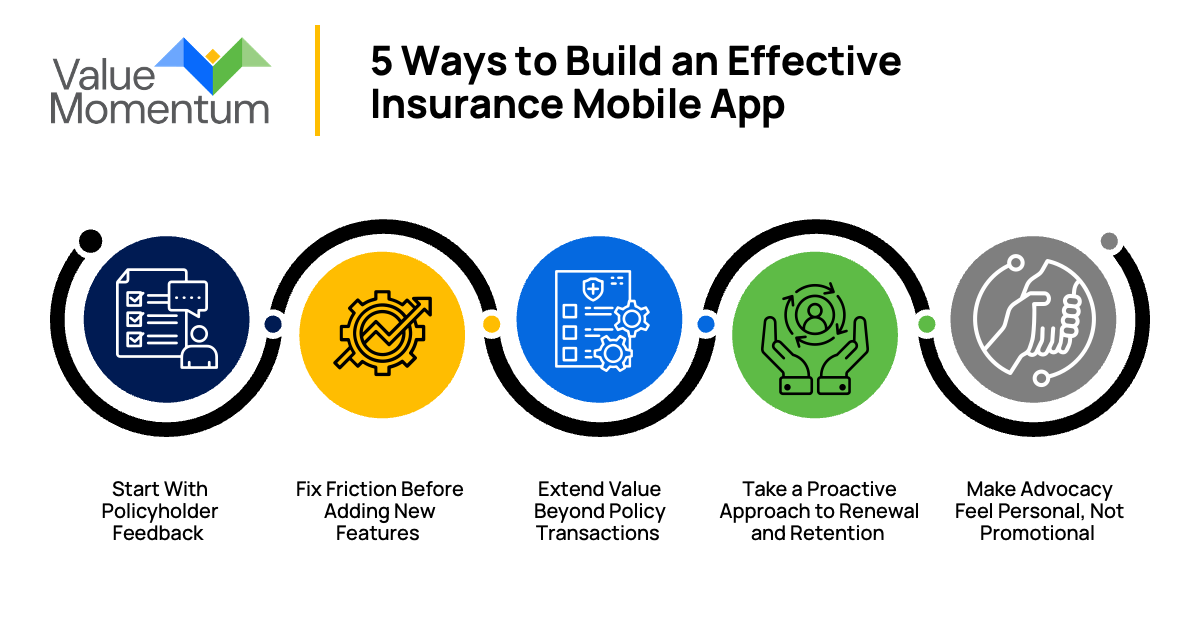
1. Start With Policyholder Feedback
The carriers leading on mobile are not guessing. According to Keynova Group’s Q1 2026 Mobile Insurance Scorecard, which benchmarks the 12 largest U.S. auto and property carriers across roughly 300 criteria, GEICO and Allstate now share the top spot for mobile app experience — with Progressive and GEICO co-leading on overall mobile user experience.
Carriers that establish regular feedback cadences — through app store reviews, in-app signals, and service interaction data — surface where to focus next before policyholders decide to look elsewhere.
2. Fix Friction Before Adding New Features
Before expanding what an app does, carriers need to ensure what it already does works without friction. According to the J.D. Power 2026 U.S. Insurance Digital Experience Study, satisfaction among insurance customers who used a virtual assistant or chatbot was 132 points higher than among those who did not — yet only 11% of customers used them.
The gap points to an adoption problem, not a capability one. Guided workflows and virtual assistants that walk policyholders through tasks like first notice of loss or coverage changes address the insurance literacy barrier that keeps many from self-serving on anything beyond basic transactions.
3. Extend Value Beyond Policy Transactions
The most durable mobile experiences extend to the things the carrier already knows about: the vehicle, the property, the exposures. Research from Tomorrow.io found that proactive weather alerts saved one carrier an average of $3,000 per hail claim.
The same principle applies beyond weather: vehicle recall alerts, cold weather battery advisories, and roadside assistance reminders all provide value entirely outside the transaction. Each relevant, well-timed touchpoint raises the baseline for what policyholders expect from the relationship.
4. Take a Proactive Approach to Renewal and Retention
As noted earlier, high-value customers are now the segment most at risk of switching. Renewal periods are predictable, which means they are manageable.
An app that monitors renewal timing, identifies policyholders showing early signs of shopping behavior, and surfaces a prompt for a coverage review gives agents the opportunity to control the conversation rather than respond to it.
5. Make Advocacy Feel Personal, Not Promotional
The most effective advocate interactions are the ones that do not feel like outreach at all. A policyholder who recently had a child, purchased a home, or added a teenage driver represents a natural opening for a coverage conversation — but only if the timing and framing are right.
An app that surfaces a prompt to review coverage after a major life event, or that reaches out ahead of renewal to acknowledge the relationship and offer a policy review, demonstrates that the carrier is paying attention. For agent-model carriers, that moment of recognition creates the conditions for a productive agent conversation.
Carriers do not need to pursue all five of these steps at once. But they do need a clear view of where their app currently sits within the 3A Framework, where the gaps are, and what the roadmap looks like. Carriers closing the relationship gap today are building something that is genuinely difficult for competitors to displace.
The App Is the Relationship
A mobile app for insurance that only processes transactions is doing the bare minimum. Carriers need to build apps that inform, assist, and advocate — showing up for policyholders proactively rather than waiting for the next renewal cycle.
The five areas outlined here are not a feature checklist. They are a framework for evaluating whether a mobile app is earning its place in a policyholder’s life and whether the carrier behind it is building something that compounds over time or can be easily displaced.
To see what a commitment to mobile customer experience looks like in practice, read the case study, “Leading Insurer Drives Mobile Customer Experience” to learn how ValueMomentum helped reimagine the mobile customer experience to drive tangible results.