


Catastrophe (CAT) losses remain among the most volatile threats to insurer and reinsurer solvency, earnings stability, and long-term profitability. Changes in the built environment, rising reconstruction costs, social inflation, and a changing climate are increasing both the frequency and the volatility of losses. Wildfire shows the shift most clearly. Climate change and development in high-risk areas are pushing losses into places the historical record barely covers.
Munich Re estimates that natural disasters produced approximately $224 billion in economic losses and $108 billion insured losses in 2025. Weather-related events accounted for 97% of insured losses. By Swiss Re’s count, it was the sixth consecutive year in which insured losses exceeded $100 billion, and that was in a year when no hurricane made landfall in the United States. Munich Re put the US outcome down to sheer luck. But luck is not a strategy. The question for the board of any insurance organization is what 2025 would have cost with a major Florida or Gulf landfall on top, and whether capital, reinsurance, and ratings would have held.
The CAT-risk landscape is also moving from isolated, well-bounded events toward risks that are systemic, connected, and emerging. Systemic risks such as technology dependencies can create accumulation across portfolios and markets. Connected risks, including geopolitical disruptions, can amplify losses through infrastructure, supply chains, and digital networks. Swiss Re Institute and LSE analyzed the risks reported by 91 Fortune 100 companies and found 24% more links between risks in 2026 than in 2019, with artificial intelligence (AI) and supply chains emerging as key points of connection. Emerging risks such as cyber and pandemic exposure challenge models because loss drivers are evolving faster than historical data can fully explain.
Insurers need to rethink their approach to CAT risk by owning their view of risk, transforming their CAT modeling function, and building CAT resilience across their enterprise. While the framework provided in this blog is built around natural CATs, where the stakes are largest today, the same structure applies to non-natural perils as well. Building CAT resilience across all types of disasters is becoming vital for insurers.
Catastrophe Resilience is Now an Enterprise Imperative
CAT risk has traditionally been managed through a familiar set of activities: model the portfolio, estimate probable maximum losses, purchase reinsurance, and respond when an event occurs. Those activities remain essential, but they are no longer sufficient.
CAT models are calibrated largely to the historical record on the assumption that the past is a reasonable guide to future exposure. Climate change has weakened that assumption. Historical patterns alone are no longer sufficient to assess the frequency, severity, or geographic distribution of CAT events under current and future climate conditions. Outputs from the Imperial College London IRIS stochastic tropical cyclone model indicate that the Category 4+ hurricanes making US landfall become 92% more likely, nearly doubling in frequency under the +2°C scenario. Not only that, the intensity of a historical Category 4 landfall event increases by roughly 8 m/s (about 18 mph). A passive, backward-looking approach leaves insurers dependent on models that may no longer reflect the risk environment and therefore vulnerable to mispricing, loss volatility, and capital strain.
The stakes extend beyond modeled losses. US carriers face rising expectations from several directions at once. The NAIC’s risk-based capital formula already includes a CAT charge for hurricane and earthquake, and the NAIC is working to add wildfire, with severe convective storm reported for information only. Best’s Capital Adequacy Ratio (BCAR) by AM Best stresses each carrier’s balance sheet against modeled CAT losses, so a weak view of risk can reach the rating. State regulators are changing the rules, too. California now allows insurers to use approved, forward-looking wildfire models in rate filings in return for commitments to write more business in high-risk areas. Each of these depends on accurate, well-governed, and auditable data available on demand. The cost of falling short is not limited to capital charges or penalties; it includes rating pressure, reputational damage, and heightened supervisory intervention.
In this environment, climate and CAT resilience should therefore be understood as an enterprise capability: the ability of a carrier to anticipate changing risks; absorb shocks within its risk appetite; maintain critical operations and policyholder service; recover effectively; and adapt its portfolio, capital, products, and operating model as conditions evolve. This definition is broader than CAT modeling. CAT models estimate possible financial outcomes. Enterprise resilience determines whether those insights are governed, challenged, and acted upon across underwriting, pricing, exposure management, capital, reinsurance, claims, operations, and strategy.
The Colonnade: A Framework for Catastrophe Resilience
Insurers need a proactive, flexible approach to enterprise risk and resilience, one that links executive direction (strategy, governance), integrated business operations (underwriting, claims), and a governed decision foundation (data, models). Done well, this approach gives leadership what it increasingly demands: a defensible compliance position, measurable gains in underwriting performance, and a framework for adopting technology with confidence.
To define what a strategic, governed, and scalable CAT risk and resilience capability looks like in the modern era, insurers can picture a colonnade. The colonnade framework clarifies the components required to mature the CAT function, reduce loss volatility, and protect surplus.
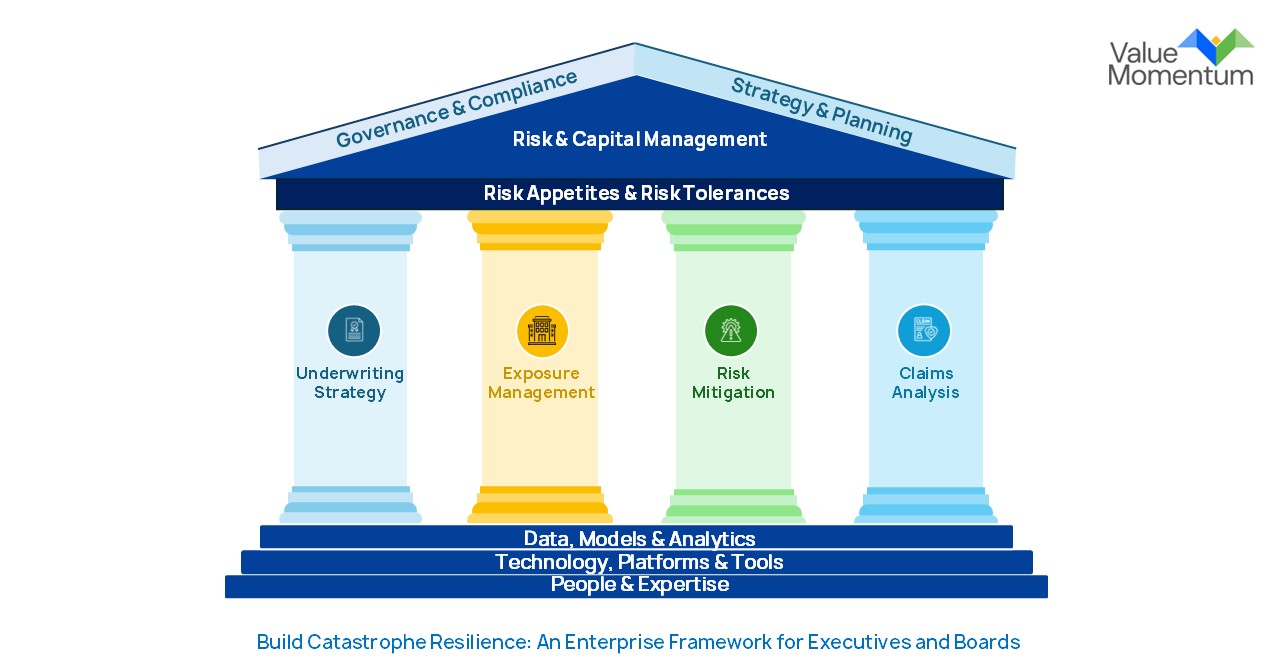
The framework includes a strategic roof, four operational pillars, and a modern data-and-technology foundation. Governance and strategy run through every level of the structure, so each component informs and reinforces the others in a closed loop rather than operating in a silo. The six pillars of a proactive CAT function sit inside this structure as the foundation. These are the capabilities the CAT function itself must hold to support underwriting, exposure, and risk management.
The Roof: Enterprise Risk and Capital Management
The roof represents the strategic decision layer that guides portfolio and capital choices, including optimization, diversification, reinsurance, business planning, governance, and regulatory compliance. Anchoring these decisions in a single, governed view of CAT risk allows leadership to evidence compliance; respond quickly and accurately to regulatory requests; and avoid the fines, reputational damage, and operational disruption that fragmented data invites.
This layer clarifies the organization’s appetite and tolerance for CAT risk across natural and non-natural perils. It also positions enterprise risk and capital management as the central decision engine, supported by four operational pillars that convert analytics into action. Robust governance and strategy form the thread that connects the roof to every pillar, keeping underwriting, exposure management, mitigation, and claims aligned to the same risk appetite.
Four Operational Pillars: Turning Analytics into Action
The roof is supported by four pillars that strengthen data analysis, prediction, and execution capabilities. Together, they reflect core themes in insurance modernization: continuous iteration and testing, spatial and advanced analytics, and a shift from risk transfer toward risk prevention. Each pillar below is framed around its executive imperative and the business outcomes it should deliver.
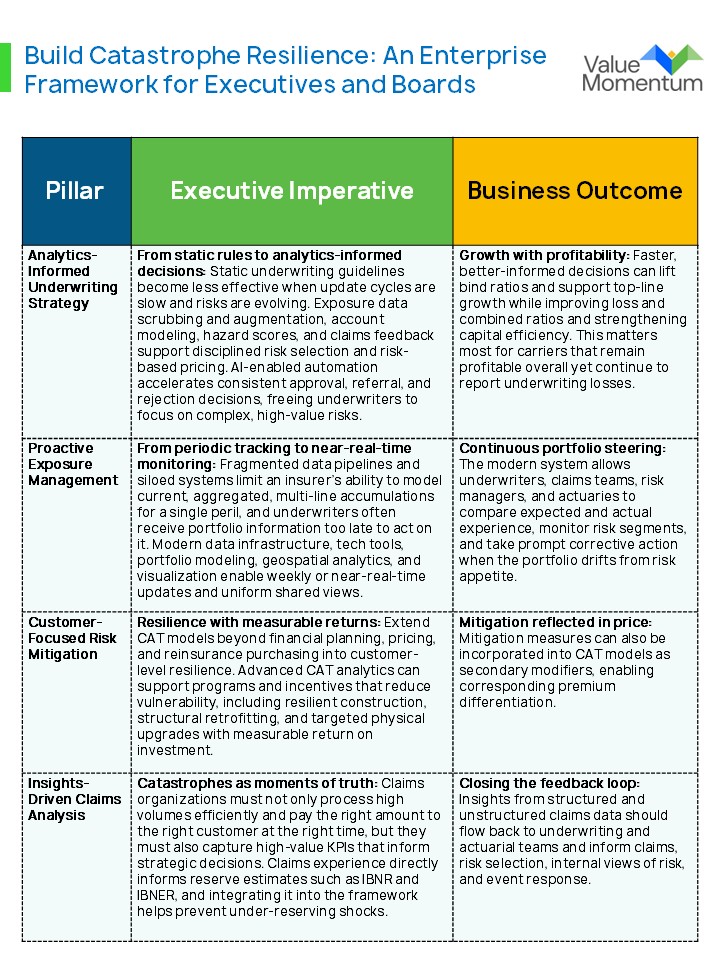
These four capabilities reduce loss volatility and protect surplus by improving risk selection, accumulation control, vulnerability reduction, and claims learning. They also give business users granular, timely insights required to price and manage CAT risk effectively. Because each pillar feeds the others, the colonnade operates as a closed loop: claims experience sharpens underwriting and reserving, underwriting decisions shape the portfolio, and portfolio insight guides mitigation. For executive leadership, each pillar should be tied to quantifiable, outcome-based measures, such as combined ratio improvement, bind ratio uplift, faster decision cycles, reserve accuracy, and FTE capacity released through automation.
However, these capabilities cannot stand without a strong foundation of data, models, analytics, and technology.
The Foundation: Data, Models, Analytics, and Technology
The colonnade stands on a robust data foundation. This foundation organizes historical and unstructured data already held within insurer systems and integrates current submission, policy, claims, and exposure data into a single, governed data platform. Combined with geospatial technologies, including geographic information systems (GIS) and remote sensing, this data core feeds the analytics, CAT and actuarial models, and dashboards that support exposure mapping, hazard assessment, and risk insights.
The foundation also requires structural transformation. Insurers must move toward forward-looking CAT and capital modeling that captures hyper-local property data, key secondary modifiers, and live data feeds. A modern data foundation shifts the organization from static, historical analysis to dynamic, continuous modeling infrastructure that produces reliable probabilistic loss estimates, which are critical for pricing; portfolio management; reinsurance strategy; and the auditable, reproducible data trail that regulators increasingly expect.
A modern data foundation is also what allows AI to scale responsibly. AI is moving rapidly into pricing, underwriting, and claims, yet in WTW’s 2026 survey of North American P&C insurers, 42% cite poor data quality or access as a significant barrier. As adoption grows, complete, well-governed data reduces bias, and transparent data lineage provides the explainability that regulators expect.
In addition to these elements of the colonnade, there is another critical element of the foundation of a truly resilient CAT function: its people. The figure places people and expertise at its base for a reason. Without CAT modelers, actuaries, data scientists, and technologists to run the framework and challenge its outputs, an insurer’s CAT function cannot truly be prepared to perform and scale. The judgment should stay in house, while partners can supply capability and capacity.
Questions the Board Should Ask
Directors do not need to run the models, but they should be able to test whether the colonnade is standing. Six questions for a board of directors to ask, one for each part of the framework, are a good place to start:
- Roof: Is our CAT appetite set in terms of capital, earnings, and rating? Who tells us when we are close to it?
- Pillar 1: Underwriting strategy. What share of our CAT-exposed premium was bound with a modeled CAT cost in front of the underwriter?
- Pillar 2: Exposure management. How current is the accumulation view we are looking at? Would we know within a week if the portfolio drifted outside appetite?
- Pillar 3: Risk mitigation. Which mitigation programs and incentives have a measured return, in lower losses or in price?
- Pillar 4: Claims analysis. How did actual claims from recent events compare with what our models predicted? Do we understand why they differed?
- Foundation: Could we reproduce last year’s CAT numbers for a regulator or rating agency within a day and explain every adjustment?
If the answers are slow, inconsistent, or depend on one person, the colonnade has a weak point, and the next large event will find it.
Achieving Catastrophe Resilience
Predicting CAT activity in a volatile world is inherently difficult. Building CAT resilience, however, is an intentional strategic choice. Insurers that make CAT modeling an integrated business capability rather than a periodic portfolio assessment can reduce risk exposure, improve capital deployment, and create competitive advantage. Underwriting teams need visibility into account-level CAT risk and how each risk contributes to aggregate portfolio exposure.
Executives should prioritize high-quality location intelligence, a robust operating model, and the infrastructure required to turn CAT modeling into a strategic enabler. A practical starting point is a targeted gap analysis with a specialized partner to assess the materiality of CAT exposure; evaluate the maturity of existing systems; and identify opportunities to apply spatial analytics, data services, AI/ML tools, and fit-for-purpose CAT models. The output should be an action plan rather than a list of benefits — each component of the framework mapped to specific, outcome-based actions and quantified targets.
Don’t leave CAT resilience to chance. A useful first conversation starts with one question. Where in your organization does CAT insight stop short of a decision? To start that conversation, contact our Risk Analytics team.