
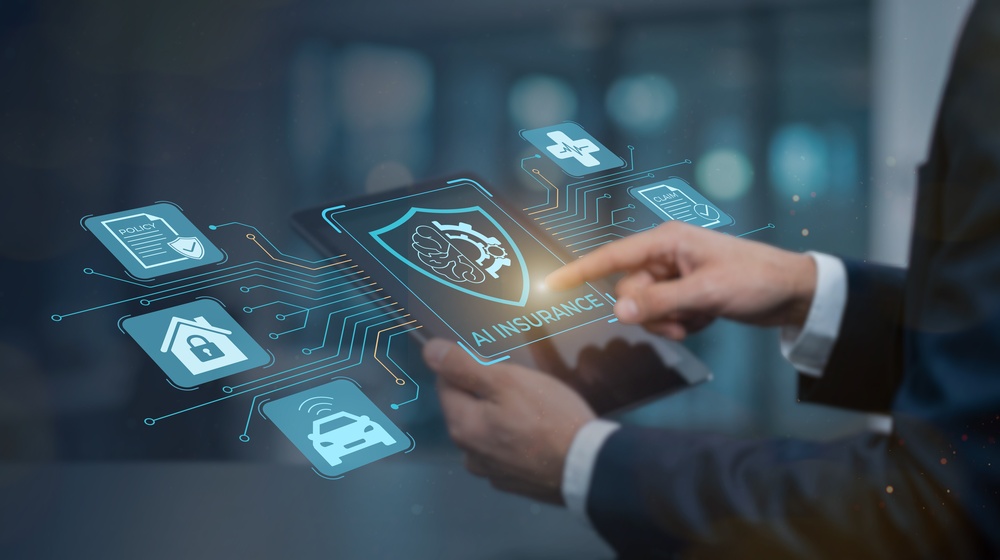
Artificial intelligence (AI) has become a normal part of carriers’ tech stacks for use cases across the property and casualty (P&C) insurance value chain. Simple capabilities like robotic process automation (RPA) and predictive analytics are making way for complex workflows orchestrated by AI agents and advanced analytics dashboards helping guide underwriters and claims adjusters in real time.
AI investments are no longer about exploration. ISG research found that 83% of insurance leaders across functions are willing to leverage AI for repeatable work, while keeping humans in the loop for high-value decision-making and oversight. This means carriers who are not investing in AI solutions will quickly fall behind their more technologically advanced peers.
With a 49.5% year-over-year increase in enterprise AI spending in 2026, according to Gartner, any organization just getting started on their AI journey is likely going to be telling a much different story a year from now. From risk assessment and fraud detection to customer experience and compliance, AI use cases for P&C insurance are continuing to grow.
Reinventing P&C Insurance Workflows With AI
The most valuable AI-led solutions combine P&C expertise and AI technology to solve concrete business problems that P&C insurers are facing today. At this year’s ITC Vegas, ValueMomentum will be highlighting AI-fueled solutions that are driving measurable business outcomes for P&C insurers through a series of demos.
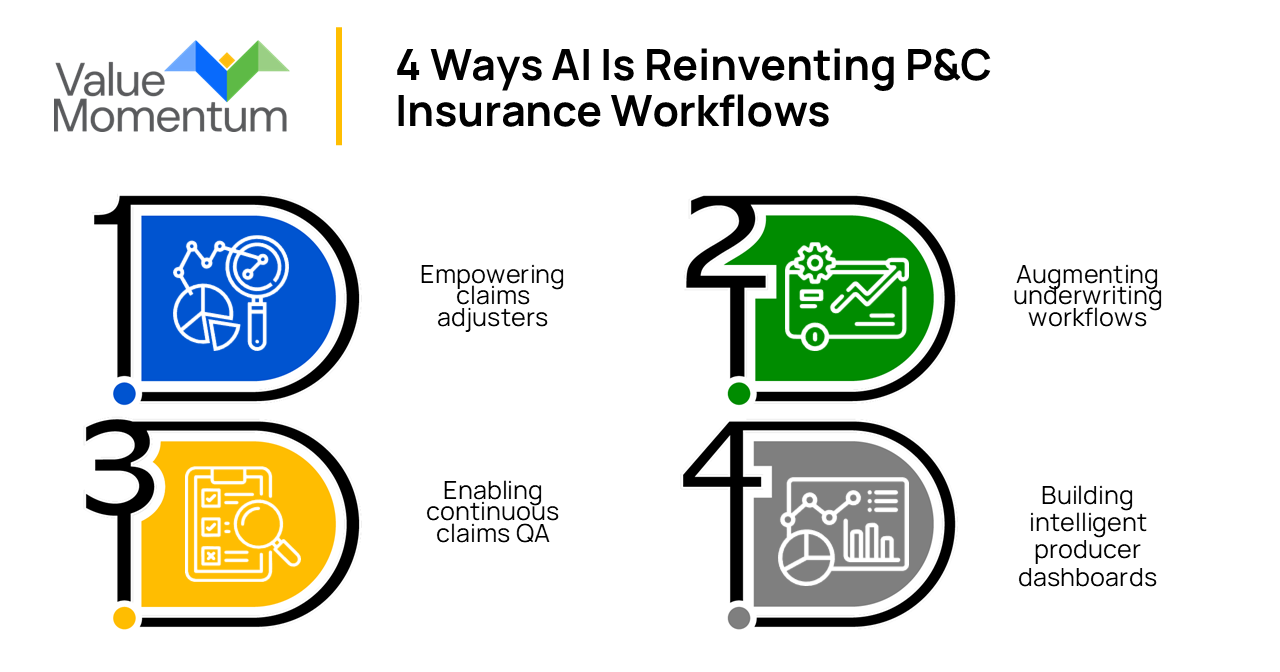
Here are four ways that P&C insurers working with ValueMomentum are driving measurable business outcomes with AI. Interested in a particular use case? Stop by booth #1810 at ITC Vegas.
1. Empowering claims adjusters. Claims adjusters play a pivotal role in the claims process, one of the most critical customer touchpoints in the entire insurance life cycle. But legacy approaches to claims handling remain heavily manual and document-dependent, requiring adjusters to move between multiple systems or lean on institutional memory of past precedent to settle complex claims.
An AI-powered adjuster empowerment framework that begins with a diagnostic phase rooted in industry benchmarks can help give adjusters the right intelligence, guidance, and quality checks directly within the workflows they already use. It is especially beneficial when these features are built into the claims platform a carrier runs on instead of layered on as a new system. AI is especially effective at summarizing claims context, surfacing precedent from similar past claims, assisting with correspondence drafting, and continuously evaluating how claims are handled throughout a file’s lifetime. For example, one Tier 1 insurer that ValueMomentum worked with reduced its claims letter cycle time from days to hours while cutting operational costs by 30%.
2. Augmenting underwriting workflows. Underwriters often struggle to prioritize the numerous submissions directed to them, and while AI is being used at some insurers to streamline submission, many experienced underwriters can be hesitant to trust the results AI delivers. When applied appropriately, carriers can streamline the submission process, triage risks to the right underwriter more effectively, and accelerate speed to quote.
Rather than attempting to automate underwriting for every type of submission, insurers can triage their submissions, using AI to identify what can be routed to straight-through processing, what can be AI-assisted with human review, and what type of risk needs to be routed to a human underwriter for full processing. ValueMomentum’s AI-augmented underwriting workbench has helped insurers accelerate their submission intake by 30-50%, with 40-60% reduction in manual data preparation, and 20-30% improvement in underwriting capacity.
3. Enabling continuous claims QA. Claims quality assurance is usually the last line of defense against leakage, and at most carriers, it is also the weakest link. Traditional QA relies on small, backward-looking audit samples that are reviewed well after a claim has closed. This often means that inconsistent handling, missed documentation, and coverage gaps are identified long after a payment has left the insurer, when there is little recourse beyond logging the finding.
Rather than sampling a handful of closed files each quarter, always-on QA can check every adjuster’s work against a carrier’s own guidelines at each milestone while the claim is still open, producing a score, a clear next step, and an audit trail within the adjuster’s existing workflow. Industry research puts indemnity leakage at roughly 7–14% of insurer’s total spend. But proprietary benchmarking data shows that fort best-in-class carriers, that percentage drops to just 3–4%. Always-on QA can help close that gap.
4. Building intelligent producer dashboards. Human agents continue to play a major role in how insurance is purchased, especially in more complex lines like commercial and specialty. A good agent experience can determine whether or not an agent refers quotes to an insurer, which has a major downstream impact on a carrier’s ability to grow. AI can help simplify the process of providing a modern digital experience for agents, from accelerating the portal development life cycle to serving as an intelligent advisor for a policy submission.
AI-driven producer dashboards can intelligently bring together quote and bind functionality, self-service capabilities, and high-caliber reporting across numerous relevant fields. Intelligent producer dashboards eliminate friction from the submission process, greatly accelerate quote and bind, cut down on data re-entry that can frustrate agents, and smooth out the renewal process.
Practical, insurance-specific applications of AI will continue to drive process improvements across all parts of the P&C value chain, spurring growth and enabling insurers’ to expand their businesses into new regions and product lines. No matter the use case, the key is to center any AI initiative around specific business needs. Success is typically found by focusing on AI solutions that are embedded directly into business workflows and integrate with an insurer’s existing core systems, ensuring that AI budgets are being used effectively.
To learn more about how ValueMomentum is driving results for P&C carriers with its P&C first, AI-led approach to innovation, stop by booth #1810 at ITC Vegas to see these AI solutions in action.