

Carrier quoting and rating systems were built for channels the industry knows well. Agent portals, comparative raters, and carrier websites send requests in predictable formats and at predictable volumes, usually with a person somewhere in the process to fill a gap or follow up on a referral.
However, artificial intelligence (AI) agents are changing these default systems. Consumers now ask ChatGPT and similar tools about coverage, and carrier apps inside those assistants return real quotes in the middle of the conversation. Adoption is early but moving quickly. Insurify reports that 5.7% of its new customers in the first half of 2026 found it through ChatGPT and other AI conversations, up from 0.15% a year earlier.
While carriers should carefully assess which lines belong in an agentic AI channel, there is a good opportunity to accelerate policy purchases and meet customers in their preferred channel. Given the emerging nature of these channels, many insurers may need to adapt their existing infrastructure to support AI-driven distribution. Systems that cannot return an accurate, individualized quote to a machine leave a carrier out of agentic AI insurance distribution entirely, regardless of brand strength or relationship history.
Five Priorities for Carriers Entering Agentic AI Distribution
McKinsey found that over the past five years, AI leaders in insurance have delivered total shareholder returns 6.1 times higher than laggards, a wider gap than in most other sectors. Agentic AI distribution is likely to widen it because the advantage will depend not only on how a carrier uses AI internally, but also on how well its systems respond when AI works on a buyer’s behalf.
Today, that mostly means a consumer asking a general-purpose AI assistant for quotes and then completing the purchase on a carrier or agency site. But existing AI assistants are evolving into AI agents that are assigned to work through the full purchasing sequence: querying several carriers at once through APIs, evaluating coverage terms and exclusions in a standardized way, weighing each option against the buyer’s stated preferences, binding the policy, and monitoring the renewal for a better option.
These five capabilities will determine whether a carrier is ready for the world of agentic AI distribution:
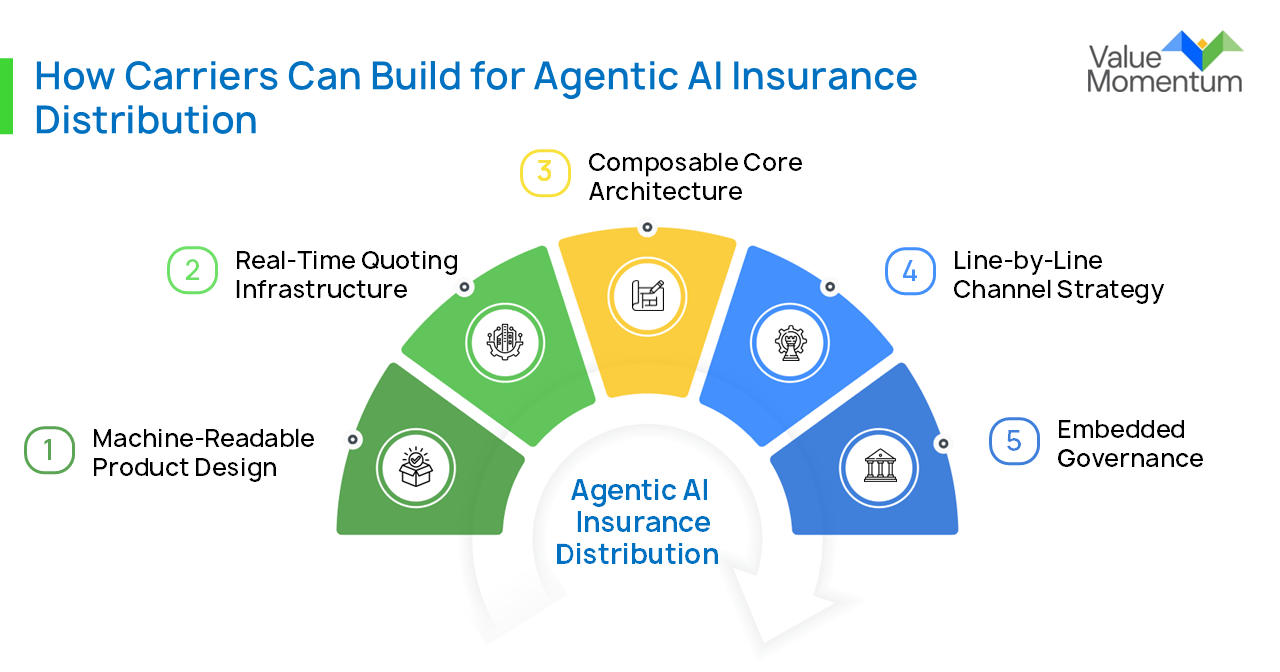
1. Machine-Readable Product Design
Coverage terms, pricing logic, and eligibility rules have to be structured for algorithmic evaluation, not just human comprehension. Products whose coverage information is available only in unstructured documents may be harder for AI agents to compare consistently and accurately across carriers.
Machine readability also protects the attributes that make a carrier different. An AI agent can only weigh what it can parse, so coverage that is better than a competitor’s but described only in policy language is invisible in the comparison. Structured coverage data, with endorsements, exclusions, and limits expressed as discrete fields, keeps a carrier from being reduced to a price and a set of limits. In commercial lines, where automated purchase is not the goal, applying the same discipline to appetite and eligibility through product content management lets an enterprise AI assistant identify the carrier as a fit.
2. Real-Time Quoting Infrastructure
The practical test is speed. An AI agent comparing several carriers will not wait for a batch process or a manual referral, and a slow response simply drops out of the result.
Liberty Mutual’s carrier-backed quoting app inside ChatGPT, launched in May, shows what this looks like in practice: The customer answers a short series of questions in the conversation and receives a quote from the carrier’s own rating engine. Carriers pricing on broad demographic proxies will return less competitive quotes, and, in an agentic AI channel, the cost goes beyond lost business. When better risks find sharper prices elsewhere, the book that remains skews toward adverse selection.
3. Composable Core Architecture
Monolithic systems built for a single channel struggle to plug into AI-native distribution layers. Composable architectures, in which pricing, underwriting rules, and policy issuance can each be reached independently through APIs, are better equipped to connect to an AI interface and to adapt as those interfaces change.
The current market shows why this matters. None of today’s leading apps bind the policy inside the conversation. Liberty Mutual and Insurify both hand the customer off to a website or agency to bind. Tuio, the Spanish insurer approved to quote inside ChatGPT in February, has said in-chat purchase is planned. When binding moves into the conversation, issuance has to be callable alongside rating, and a carrier whose rating and issuance are locked inside one core system will be rebuilding under pressure.
4. Line-by-Line Channel Strategy
An AI capability is not the same as an AI channel strategy. The second requires decisions about which lines to expose, on which platforms, and through whom. Tuio’s ChatGPT quoting app, built on Waniwani’s AI distribution infrastructure, illustrates this shift. With similar AI applications extending to platforms such as Anthropic’s Claude, carriers must consider a multi-platform distribution strategy rather than relying on a single AI ecosystem.
Who presents the product matters as much as where. Insurify’s expanded ChatGPT app lets some customers complete their purchase through Insurify’s own agency, which means the aggregator owns the customer relationship at the moment of sale. A carrier-built app, like Liberty Mutual’s, keeps the carrier’s own product and presentation in front of the buyer. Carriers competing on service rather than price have a clear reason to prefer the second model, and early presence in these channels is likely to compound the way early search investment did.
5. Embedded Governance
Explainability, bias testing, human escalation pathways, and clear documentation for state regulators cannot be retrofitted into AI-driven distribution after launch. The carrier remains accountable for every quote and every bound policy, whichever interface produced the transaction.
That means logging every request an AI agent submits and every response the carrier returns, versioning rating logic so any quote can be reproduced on demand, and defining clear triggers for routing a request to a licensed human when it falls outside appetite or beyond what a standardized product covers. Embedding these controls from the outset can make expansion across products and states more efficient while ensuring that applicable filing, licensing, and regulatory requirements continue to be addressed.
None of these capabilities has to be finished before a carrier enters an agentic AI channel, but they do have an order. For most carriers, the place to start is pricing and rating modernization, because the rating engine sits underneath every other priority on this list.
Building for the Buyer That Is Already Here
Agentic AI insurance distribution will not arrive all at once. It will move at different speeds across personal lines, commercial lines, and specialty, fastest where products are standardized and pricing is transparent. The carriers in the strongest position will be the ones that treat it as an architecture decision, made line by line, rather than as a marketing experiment bolted onto systems designed for a web form.
Each of these capabilities already improves speed to market, pricing accuracy, and regulatory readiness in every other channel. AI agents simply make the gap between carriers that have them and carriers that do not visible in milliseconds.
The machine is already asking for quotes. What matters now is whether a carrier’s systems can answer.
Want to learn more about building pricing and rating systems that can operate in real time? Download the whitepaper “How to Drive Business Agility With Pricing and Rating Modernization.”