A few weeks ago, thousands of insurance technology professionals gathered at this year’s ITC Vegas to share how they’re advancing the future of insurance technology. The theme of the conference was “The Horizon of Possibilities: Predict, Prepare, Progress”, and the possibilities emerging due to artificial intelligence (AI) and other leading technologies were on full display across both the showroom floor and the conference sessions.
But there was a change from previous years, where conferences focused on AI. This year, sessions, demos, and summits went beyond the possibilities to focus on how ITC attendees and sponsors are driving real-world business outcomes with targeted AI use cases. ValueMomentum’s team, for example, shared AI-powered demos helping insurers deliver business outcomes across the value chain, including empowering claims adjusters, augmenting underwriting workflows, enabling continuous claims quality assurance, and building intelligent producer dashboards.
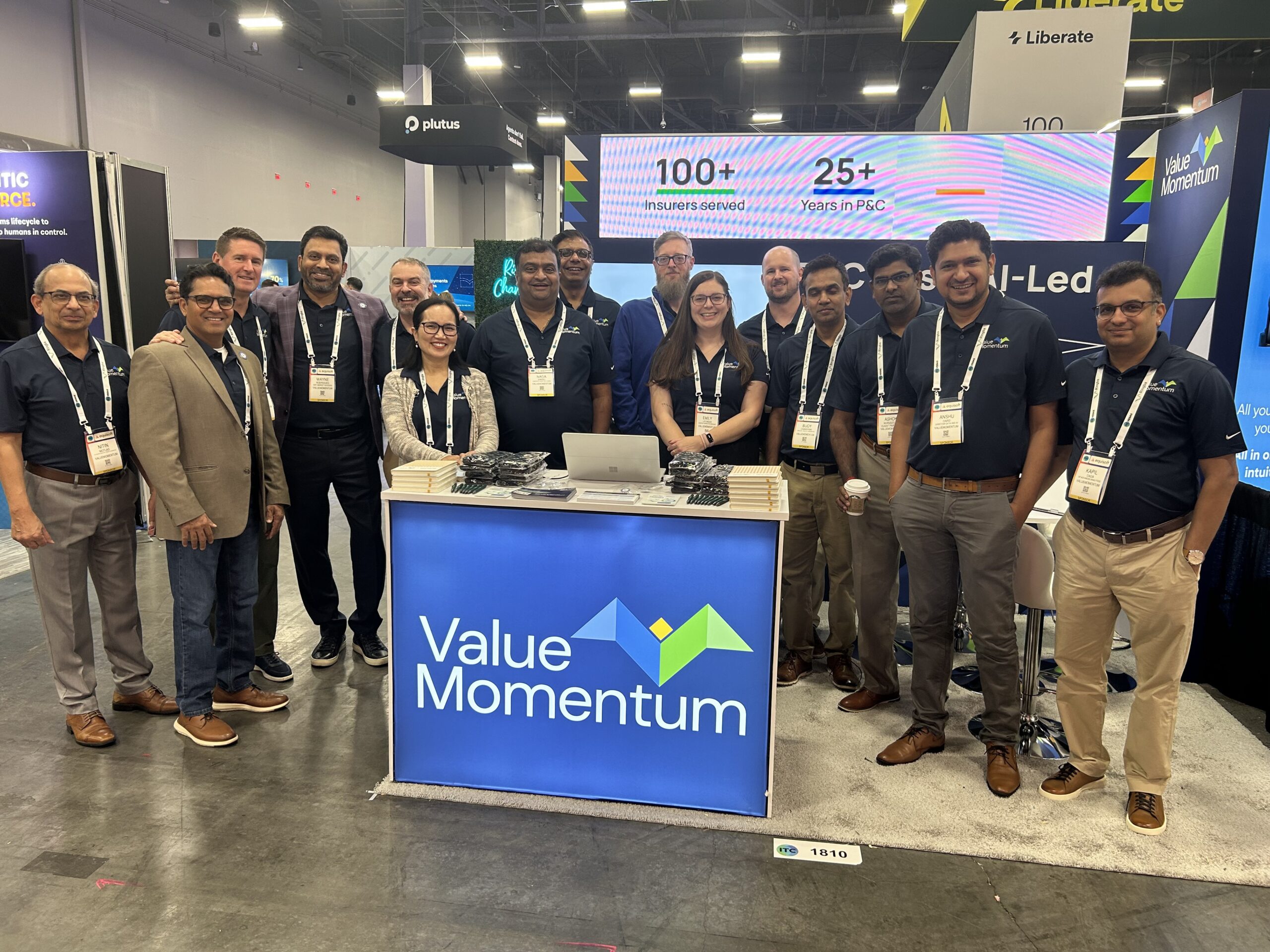
From reimagining embedded insurance to underwriting policies for autonomous vehicles, this year’s conference carried actionable insights across the property and casualty (P&C) value chain.Here are some of the ValueMomentum team’s major takeaways from ITC Vegas 2026:
Here are some of the ValueMomentum team’s major takeaways from ITC Vegas 2026:
1. AI continues to enhance human expertise, not replace it.
The organizations yielding the greatest returns on their AI investments are focusing on repurposing their human capital, not replacing it. Successfully incorporating AI across an enterprise requires a shift in thinking, evaluating how to better serve customers, where efficiency can be gained, and what tools can help drive those business goals.
Speakers emphasized that business fundamentals remain critical. AI can bring speed, but without forethought and a business strategy in place, it may not drive any meaningful results for an organization. This strategy relies on bringing the business and IT together earlier and more often, and by encouraging teams to figure out how AI can be most beneficial to their existing practices. Insurers are seeing true results in software engineering, for example, by training a few people on each team on how to gain efficiencies in AI and institutionalizing the practice.
2. The definition of risk is changing.
As insurers are incorporating AI into more workflows and evolving their offerings to cover AI capabilities or tools, they are rethinking their approach to risk. Speakers emphasized that the insurance industry has gone through many rounds of emerging risk, but that the greater challenge this time is the speed of the change. Insurers are investing in understanding the risk as well as how the risk is being used.
This includes exploring new coverage types like AI liability and autonomous vehicle insurance as well as understanding the risk factor of using AI across enterprise operations, such as AI pulling from unapproved or unverified documents, hallucinations, or even people who have lost their jobs. Speakers pointed out that there is no such thing as a silent risk, as silent risks only remain so until they are tested. This is why human-in-the-loop practices and firm governance frameworks around AI usage are pivotal to successfully leveraging AI at any insurance organization.
3. Move over, GenAI: Agentic AI is here.
The past few years, generative AI (GenAI) has been the star of the show at every conference. But now, agentic AI has firmly taken the lead. Conference sessions covered topics like leveraging agentic AI for operational efficiency, the data and analytics required to maximize investments in AI agents, and how to select use cases for agentic AI, and product demos highlighted ways that agentic AI is improving workflows like claims handling or policy distribution.
The meaning of AI maturity will continue to evolve alongside the technology; as we move toward 2027, that means being comfortable understanding where and how to leverage AI agents across the P&C value stream. Insurers who are farther along in their agentic AI journey emphasized the importance of strong governance layers and transparency surrounding AI decision-making, as well as focusing on specific use cases and testing the results before scaling any agentic workflows.
Insurance innovation continues to accelerate across the P&C ecosystem as carriers take agentic AI pilots into production, evolve their offerings to accommodate new risks, and rethink the way their enterprise operations should function. All of these trends were evident across the entirety of this year’s ITC Vegas, and they will no doubt continue to move the industry forward as we near the end of 2026.
What insurers need to remember is that innovation thrives when there is a strong enterprise foundation in place, risk management remains central to every new effort, and any AI decisions being made are well governed and traceable.
To learn more about how insurers are rethinking their operational efficiency with innovative new AI capabilities, read our whitepaper “Rethinking Insurance Software Delivery With AI.”