
Insurance broker stocks fell sharply on February 9, 2026 after Insurify announced what it called the industry’s first ChatGPT insurance app. The S&P 500 Insurance index had its steepest single-day drop since October at 3.9%, and Willis Towers Watson finished 12% lower in its worst session since 2008. No catastrophe had occurred, and no regulator had acted. Instead, a quote comparison tool had moved into a chat window.
Insurify compares quotes; it doesn’t buy policies. But that same day, Spanish insurer Tuio became the first carrier cleared to quote its own home policies inside ChatGPT, with in-chat purchase expected to follow. That is agentic AI in insurance distribution: The buyer never opens a carrier site or calls a human insurance agent.
This policy purchasing evolution has exposed a question many carriers haven’t answered, however. Policies can be quoted and bound inside an agentic conversation, but should they be? The debate since has been framed as a binary: build for AI agents or disappear from the short list.
In practice, though, more nuance is required. Instead of assuming that human agents are now obsolete, multiline carriers should frame the question differently. Which parts of the book gain from agentic AI distribution, and which lose something in translation?
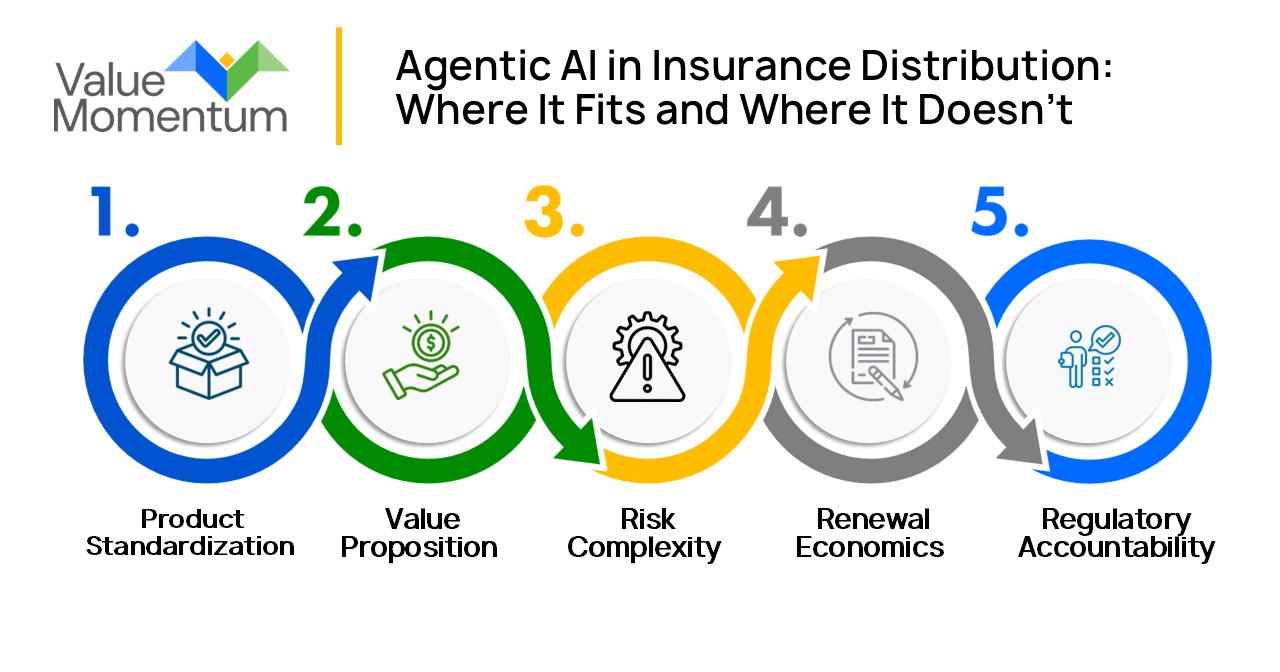
Five Factors That Determine Where Agentic AI Fits in Insurance Distribution
Nearly half of new auto policies are now purchased through digital channels, up from 36% five years ago, and shoppers receive an average of 3.5 quotes apiece, the highest in the 20-year history of the J.D. Power U.S. Insurance Shopping Study. Personal auto buyers already behave the way an agentic AI-mediated channel assumes: comparing several carriers, deciding largely on price, and transacting without a person involved.
But much of the commercial book does not. Five factors separate the lines where an agentic AI buyer improves the transaction from the lines where it detracts from the buying experience.
1. Product Standardization
Personal auto, renters, and homeowners policies are built on comparable structures. Statutory minimums and standard forms limit how far two quotes can diverge, so an AI agent can compare like against like and produce a result the buyer can trust.
However, commercial lines resist that comparison. Manuscript endorsements and carrier-specific form language mean two policies at identical premiums can carry different protection. An AI agent comparing a businessowners policy against a package policy is comparing labels, not coverage.
Standardized small commercial sits between the two, and it is where most carriers will first meet this question. The shift is a gradient rather than a cliff edge, moving fastest where products are standardized and pricing is transparent, and slowest in complex commercial and specialty lines where underwriting judgment remains a differentiated input. A simple businessowners policy comes into range of automated comparison well before a manuscripted mid-market account. Standardization, not premium size, sets the order of exposure.
2. Value Proposition
Inside an AI-agent-mediated channel, a carrier is reduced to what an API returns: a price and a set of limits. Everything that differentiates it disappears.
For a carrier competing primarily on price, that is a fair trade, provided leadership accepts the consequence: Whoever prices lower next quarter wins the short list. For a carrier whose retention rests on service, advocacy, or claims handling, the tradeoff is worse. It strips out the attributes the customer is paying for and presents the carrier as a row in a table it did not design. Comparative raters have long posed this problem, and agentic AI distribution removes the friction that limited their effects.
3. Risk Complexity
Personal lines risk arrives as structured data the buyer already has on hand: vehicle, address, driving record, etc. An AI agent can collect it and produce an accurate quote.
Commercial risk requires interpretation. Operations change and contractual obligations create exposures, and applicants routinely do not know what they have failed to disclose. The value a human agent adds is not the quote. It is finding the gap the applicant never thought to mention, and that work does not translate into a structured query.
Agentic technology still has a role here, but the role is discovery rather than purchase. An AI assistant that pre-qualifies specialist brokers leaves the placement to the human expert, and the enterprise platforms already embedded in corporate workflows are the likely route. For example, a risk manager working inside Microsoft Copilot or SAP can have coverage reviewed and a short list assembled before any human conversation begins. The relationship survives. What changes is which carriers and brokers are in the set when the call gets made, which makes discoverability a commercial lines priority even where automated purchase is not.
4. Renewal Economics
Agentic AI distribution makes switching nearly frictionless, so the annual renewal becomes a persistent point of exposure. A consumer AI agent can review a policy against dozens of carriers at once, on a schedule the policyholder never thinks about. Where retention depends on inertia, that inertia is about to be automated away, and books priced on sticky renewals will be repriced.
Commercial renewal, by contrast, is a conversation about a risk that has changed over 12 months, and the account review is part of what the customer buys. Carriers should ask which parts of the book retain on relationship and which on friction, because only one survives automated renewal review.
5. Regulatory Accountability
The first four factors are commercial judgments, but the fifth is not. Rate and form filing requirements govern a policy regardless of the channel through which it is sold. A policy quoted inside a chat window still needs approved rates and forms behind it, filed through SERFF or directly with the department, exactly as one placed by an AI agent does.
Accountability does not transfer to the platform either. The NAIC’s Model Bulletin on the Use of Artificial Intelligence Systems by Insurers sets governance expectations for AI used across underwriting and claims, and states have been adopting or adapting it since. Colorado’s SB21-169 restricts the use of external consumer data and AI where it produces unfair discrimination in underwriting, and California, New York, and Illinois have moved in similar directions. When an AI agent binds coverage on a consumer’s behalf, the carrier still answers for the result.
An agentic channel cannot be run outside the governance perimeter. Audit trails and human escalation pathways apply from the first quote, an argument for entering line by line rather than all at once.
Read together, the five factors point the same way: This is a decision to make line by line, not once for the whole book. But it is clear that carriers have to decide quickly how fast to move for each line.
The Shape of a Reasonable Bet
Insurance has seen a distribution technology arrive with this much certainty before. Voice assistants were positioned as the next front door to commerce, and the reality proved narrower. There was heavy adoption in a few well-suited transactions, yet little change elsewhere. Agentic AI distribution looks similar, if larger in scale.
That argues against both extremes. Rebuilding a distribution model around a channel this young is premature, and sitting out leaves a carrier invisible where algorithmic comparison already happens. Carriers may benefit the most by taking the position in between: Make products discoverable and machine-readable across the portfolio, since discoverability compounds; transact through AI agents in standardized, price-competitive lines; and keep human placement where underwriting judgment is the product.
The carriers that struggle will be the ones applying a single answer across a book that needs five.
Deciding which lines belong in an AI agent-mediated channel is one question. Whether pricing and rating can answer in real time is the next. To learn more, download our whitepaper, “How to Drive Business Agility With Pricing and Rating Modernization.”