

For decades, a property and casualty (P&C) insurer’s public website had one main job: Tell customers what products the insurer covered and help them find an agent. It was a digital brochure of sorts and a fundamentally passive platform.
But that era is long over. According to J.D. Power’s 2025 U.S. Insurance Digital Experience Study, nearly half of insurance shoppers now complete purchases through digital channels. But the quality of those experiences remains uneven. While having a modern digital experience platform (DXP) for insurance is important, carriers need to ask themselves: Is the investment changing how customers buy, how teams operate, and how the business grows?
DXPs are the digital front door to a company, where brand promise, product complexity, customer intent, agent relationships, and operational capability converge. If those elements do not work together, the website exposes the seams in the carrier’s operating model.
Four Operating Disciplines of a Growth-Focused DXP
P&C carriers have invested heavily in modernizing their DXPs, yet many still struggle with abandoned quote journeys, outdated product content, fragmented digital handoffs, and slow campaign execution. The problem usually isn’t the platform itself. Instead, issues arise when an insurer implements a new platform without establishing the operating disciplines needed to reap business value from that investment.
Without a disciplined approach to insurance website content management, even a modern enterprise DXP can produce an experience that feels like an out-of-touch brochure. This execution gap is common across the industry. None of the 20 insurers evaluated in the Corporate Insight 2025 P&C Insurance Experience Benchmark finished in the top tier, signaling that even carriers with mature investments have not yet realized the full potential of digital experience.
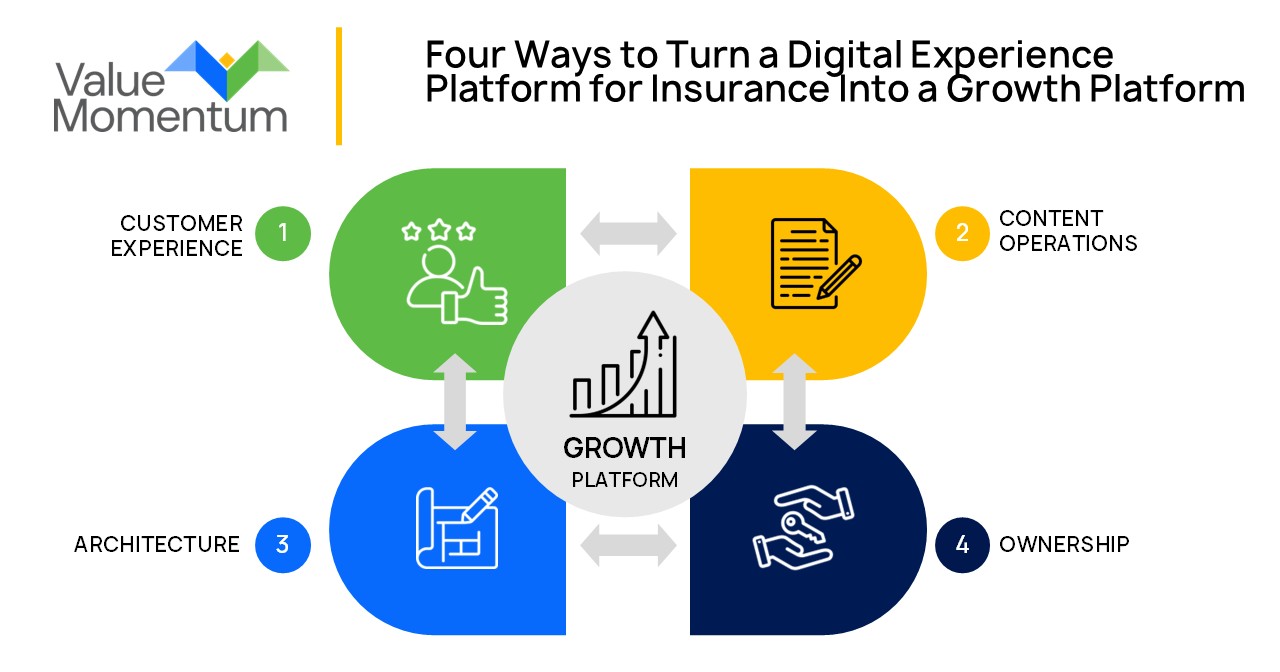
A DXP becomes a growth platform only when customer experience, content operations, architecture, and post-launch ownership work together as a continuously managed business capability. The four disciplines below help leaders identify where customer intent is being lost, where operating friction is slowing the business, and where targeted intervention can unlock measurable value.
1. Experience: Build for Buyers, Not the Carrier
Many P&C carrier websites are organized by the way the carrier itself views its products and offerings: personal auto, homeowners, commercial package, umbrella, and more. But that’s not how buyers are thinking about insurance.
First-time homeowners may worry about storm damage or a fallen branch hitting a neighbor’s car. Parents may need guidance when a teenager starts driving. Small business owners may ask whether they are liable if a customer is injured on their premises.
A modern website needs to present products through the customer’s lens. Answers to real questions need to be easy to find, easy to understand, and easy to act on.
Where to begin: Journey research, experience audits, information architecture, usability testing, and conversion analysis can reveal where customer language and carrier structure have drifted apart.
ASK YOURSELF:
Does our website reflect the way our organization thinks about its products—or the information our audience needs to find and act on?
2. Content: Empower Business Teams Without Compromising Governance
Content is the most perishable asset on a carrier website. Coverage language, state requirements, product details, and disclaimers all change. Campaigns launch. The questions customers need answers to evolve.
For P&C carriers active in multiple states, serving niche communities, or launching new products, content freshness is more than a marketing issue. Out-of-date content can impact a carrier’s credibility, create compliance issues, and hinder sales performance.
Modern DXPs should let marketing, product, and compliance teams create and publish content through governed workflows with reusable components, permissions, and review processes. This doesn’t mean that IT should be out of the loop completely, but instead of getting bogged down in routine content processes, they should focus on platform enablement, security, integration, and scalability.
Where to begin: A content operating model assessment can clarify life-cycle ownership, workflow bottlenecks, component reuse, compliance controls, and the publishing capabilities business teams need to move faster safely.
ASK YOURSELF:
Can marketing publish a campaign landing page or a state-specific content update without waiting for an IT release — while preserving review, approval, and compliance controls?
3. Architecture: Build for Continuous Evolution
Website launches should be the beginning of a new era, not simply the end of a project. Migrating old content, stabilizing the new DXP, and pushing a site live are important steps, but the website needs to be viewed as an evolving entity.
Carriers must continually launch campaigns, personalize content for key audiences, and maintain accessibility. They must also create seamless handoffs from the website to quote, agent, claims, and customer support journeys.
When a DXP’s architecture is too rigid, every enhancement becomes a lengthy project. Reliable integrations must preserve customer intent across handoffs, while consistent tagging and robust analytics help the business understand what works and what does not. A modern architecture should enable continuous improvement — not merely support the initial launch.
Where to begin: Architecture and integration discovery can identify rigid dependencies, broken handoffs, data gaps, and opportunities for modular modernization without forcing another large-scale re-platforming effort.
ASK YOURSELF: Is the site designed for continuous improvement, or does every meaningful change require a costly platform overhaul?
4. Ownership: Establish Accountability After Go-Live
One of the most overlooked dimensions of a modern DXP is what happens once a website is launched. Everything might look perfect on go-live day, but someone needs to be responsible for keeping that perfection up.
Who keeps content current and archives it when necessary? Who prevents accessibility issues from accumulating? Who monitors search engine optimization (SEO), answer engine optimization (AEO), and generative engine optimization (GEO)? Without clear ownership, insurers risk fragmented campaign pages, unreliable analytics, and unresolved performance problems.
Marketing, UX, product, compliance, data, and technology teams need explicit decision rights and shared accountability for outcomes. Depending on the carrier’s capabilities, that model may be internal, managed, or hybrid. No matter what the model is, it needs to include a defined product owner, a regular performance cadence, a prioritized enhancement backlog, and clear responsibility for platform health.
Where to begin: An operating model workshop can establish decision rights, governance forums, performance measures, funding, release cadence, and the right balance between internal ownership and specialist support.
ASK YOURSELF: Who owns the website experience after launch, how is accountability measured, and how often are performance and priorities reviewed?
From Static Experience to Growth Platform
No matter what a DXP’s visible symptoms are, whether that is low conversion, stale content, weak personalization, or incomplete analytics, the root cause often sits across several disciplines. Carriers need to have a focused conversation about where value is leaking, which business outcome matters most, and which discipline offers the highest-leverage starting point.
That discussion should be anchored in outcomes, not simply launch completion or platform uptime. Relevant measures include quote-start and completion rates, content publishing cycle time, search success, accessibility quality, digital handoff completion, content freshness, and conversion by audience or market.
A short diagnostic assessment can connect journey evidence, content operations, platform constraints, analytics, and ownership into a practical roadmap.
To learn more about insurers are revitalizing user experiences with modern interfaces, watch our on-demand webinar “Ask the Experts: Modern Agent Portals: Elevating Experience and Driving Profitable Growth.”