
For decades, career progression in P&C insurance followed a familiar pattern. Entry-level roles provided exposure to volume and variation, mid-career roles built judgment through repetition, and senior positions rewarded accumulated expertise. That model assumed one constant: that work itself would reliably create learning opportunities over time. As agentic AI takes on more responsibility across underwriting, claims, and IT operations, that assumption no longer holds.
Across industries, this shift is already reshaping how skills are developed. According to McKinsey Global Institute, more than 70% of the skills used in today’s jobs are expected to remain relevant, even as AI increasingly performs routine and context-specific tasks. The change is not “which skills matter,” but how and where those skills are applied, with human roles shifting toward interpretation, oversight, and complex decision-making.
As automation moves earlier into insurance workflows, the experiences that once formed the foundation of career progression are becoming less consistent — and in some cases, disappearing altogether. For insurers, this creates a challenge at the intersection of technology and talent strategy. As agentic AI reshapes how work gets done, insurers must rethink how career pathways are built, measured, and sustained to preserve long-term operational resilience.
Cultivating Career Progression for AI-Ready Insurance Talent
As agentic AI absorbs more foundational work across underwriting, claims, and IT, the traditional career ladder in P&C insurance begins to strain. Progression models built on time, repetition, and exposure assume that doing the work naturally builds judgment. But when systems increasingly handle intake, classification, and early decisioning before a human becomes involved, learning no longer accumulates predictably.
This shift is already visible across large insurers. Organizations such as Allstate have introduced patents describing the use of generative AI (GenAI) across claims handling, underwriting support, and customer communications to improve speed and consistency. These deployments reduce manual effort and bottlenecks, but they also change where humans engage with the work. Early-career roles see less volume-driven exposure, while mid-career roles rely more on oversight and exception handling than on hands-on execution.
The result is not a need to accelerate careers faster up the same ladder, but to rethink the ladder itself. Below is a modern career architecture that maintains judgment, learning, and long-term capability within an AI-driven operating model.
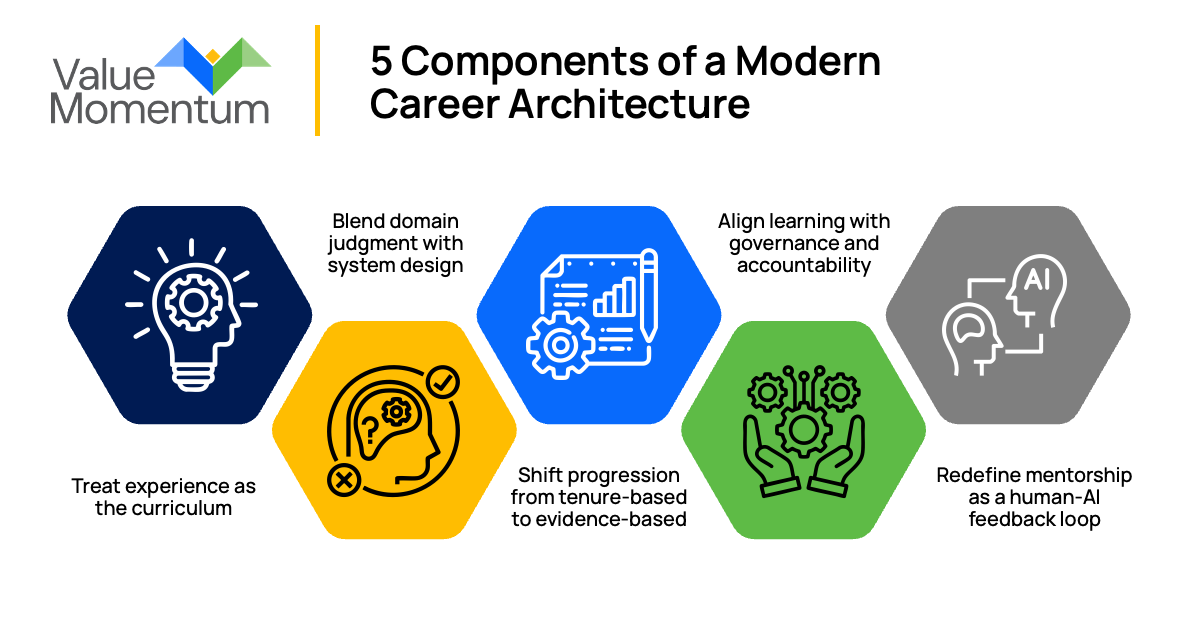
1. Treat experience as the curriculum.
Professional advancement can no longer depend on time spent in a role. Instead, learning must be built around curated experiences that expose employees to decision-making, variation, and context. As AI handles routine execution, humans gain expertise by interpreting outputs, reviewing edge cases, and understanding why systems behave the way they do.
In practice, this means progression is defined by the breadth and depth of an employee’s exposure, not by tenure alone. Experience becomes intentional, visible, and measurable rather than incidental.
2. Blend domain judgment with system design.
As AI systems increasingly shape workflows, roles naturally evolve. Professionals are no longer just users of systems; they influence how those systems reason, escalate, and adapt.
Future-ready roles combine insurance expertise with responsibility for shaping AI behavior. Underwriters refine how risks are flagged and summarized. Claims professionals influence triage logic and escalation thresholds. IT and operations leaders focus as much on monitoring and improving AI workflows as on maintaining infrastructure. Career growth reflects increasing ownership of both judgment and system behavior.
3. Shift progression from tenure-based to evidence-based.
In a traditional ladder, advancement often signals time served. In an AI-enabled environment, that signal weakens. What matters more is how effectively individuals apply judgment, improve outcomes, and elevate system performance.
Agentic systems make this possible by capturing decisions, feedback, and outcomes over time. Progression can be tied to demonstrated impact, such as improving decision quality, reducing uncertainty in edge cases, or strengthening consistency across workflows. Careers become more transparent, data-informed, and grounded in contribution rather than longevity.
4. Align learning with governance and accountability.
As AI plays a greater role in regulated decision-making, learning and governance increasingly intersect. Employees must understand not only what a system does, but why it behaves the way it does and how to intervene responsibly.
This convergence creates new career paths that blend risk, compliance, and operational expertise. Professionals who can interpret AI behavior, ensure traceability, and uphold fairness become central to both talent strategy and regulatory readiness. Career architecture must reflect this reality by valuing governance fluency alongside technical and domain expertise.
5. Redefine mentorship as a human-AI feedback loop.
Mentorship does not disappear in an AI-driven organization; it simply changes form. Senior experts spend less time executing work and more time guiding both people and systems. Their judgment is embedded through feedback, calibration, and review rather than through direct task ownership.
At the same time, AI systems expose reasoning paths that help newer employees learn faster. Mentorship becomes a continuous loop: Humans train AI through feedback, AI teaches humans by making decision logic visible, and expertise advances on both sides. This is the modern equivalent of learning beside a master craftsman.
When designed with intention, agentic AI does not eliminate career progression. Instead, it forces insurers to rethink how progression works, shifting from ladders built on repetition to architectures built on judgment, learning, and impact.
Preserving Career Pathways in an AI-Driven Insurance Future
Agentic AI is changing more than how work gets done in P&C insurance. It is reshaping how expertise is built, how careers progress, and how organizations sustain judgment over time. While automation delivers real gains in speed and consistency, it also challenges long-standing assumptions about how learning happens through execution alone.
By redefining progression around exposure, judgment, system stewardship, and accountability, carriers can ensure that expertise continues to grow alongside intelligent automation. In doing so, they protect not only individual career paths, but also the institutional knowledge and resilience that underpin long-term performance.
For a closer look at how agentic AI is reshaping insurance roles — and how leaders can build resilient career pathways alongside automation — read my whitepaper, “The Vanishing Apprenticeship: Rebuilding Career Pathways in the Age of Agentic AI.”