



Delivering an intuitive, consistent user experience (UX) for both internal and external stakeholders has become a critical component of property and casualty (P&C) insurers’ growth strategies. But creating and scaling a modern UX requires significant investment in application development.
To drive the results required to stand out in a crowded marketplace, insurers are leveraging various application development strategies to enhance their UX. While low-code/no-code solutions and bespoke development can help, many insurers are turning to their core systems providers’ digital development platforms, such as Guidewire Jutro Digital Platform, as the most efficient way to modernize their experiences.
These platforms help insurers maintain the architectural consistency and upgrade schedule of their core systems providers through reusable components. Leveraging solutions like Jutro can also help reduce maintenance costs and accelerate application development.
However, it’s not always clear how to get the most value out of native platforms and capabilities. Here are some answers to major real-world questions we’re hearing from insurers leveraging Guidewire on how to deliver industry-leading experiences.
Frequently Asked Questions About Jutro
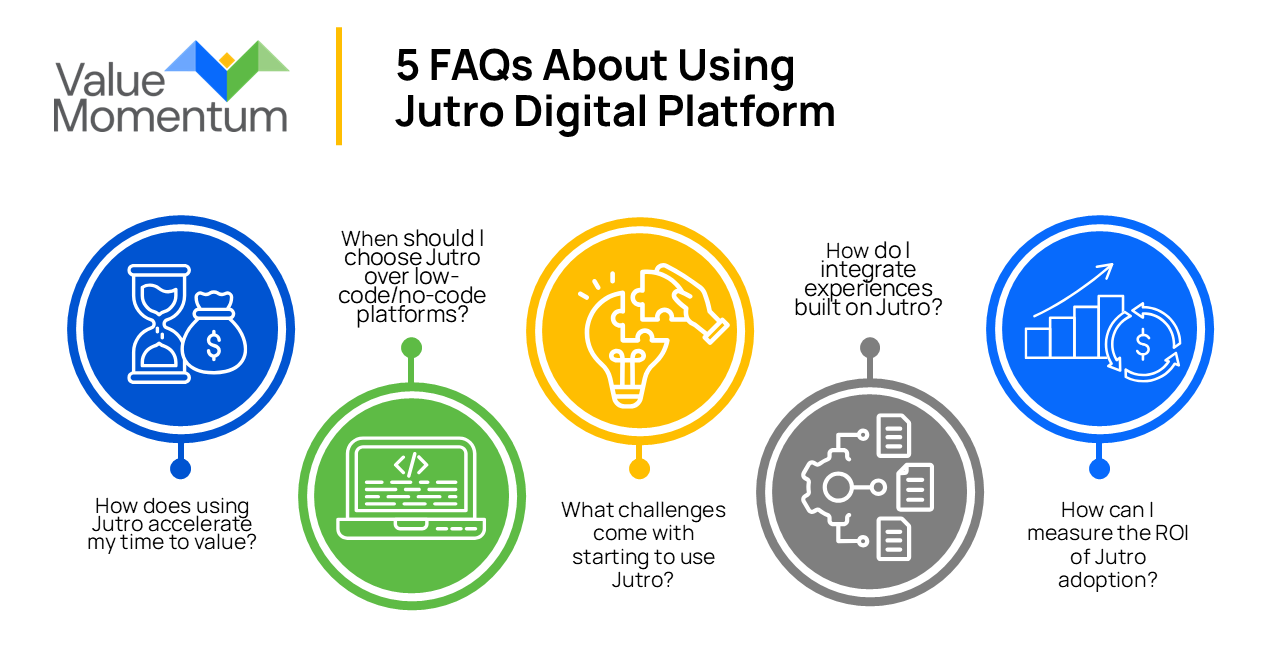
1. How does using Jutro accelerate my time to value?
Jutro improves the application development process by reducing complexity and accelerating delivery for digital experiences that matter most to insurers.
At its core, Jutro provides a set of React libraries, a design system, and pre-built experience templates. Rather than building and styling each interface from scratch, development teams can assemble screens quickly using components that already incorporate accessibility standards, user interface (UI) consistency, and pattern best practices.
Building from a standardized foundation minimizes common sources of rework, such as inconsistent layouts, late-stage UX fixes, or accessibility gaps, allowing teams to focus on business workflows and customer journeys instead of foundational UI concerns. The result is shorter delivery timelines, more predictable quality outcomes, and a development experience that scales across portals and lines of business.
Because Jutro aligns with modern, API-driven architectures, it also supports maintainability and long-term adaptability. UI layers remain decoupled from back-end services while maintaining clean integration patterns, a key requirement for evolving digital platforms in insurance.
2. When should I choose Jutro over low-code/no-code platforms or custom development?
When applications are peripheral to core operations, support narrow or internal use cases, or require deeply bespoke interactions, teams may want to opt for low-code/no-code platforms or custom UI approaches. However, those tools often struggle with insurance workflow complexity at scale. Multi-step, conditional journeys across products, regions, and roles may become brittle and hard to govern.
Jutro is purpose-built for insurance and ideally suited for experiences that interact directly with Guidewire policy, claims, and billing systems, while also connecting to non‑Guidewire core and adjacent systems to orchestrate journeys across a heterogeneous application landscape. Those experiences can be delivered as standalone Jutro applications or embedded into existing, non‑Guidewire digital portals when insurers want to modernize UX without replatforming their front-end stack.
For example, Jutro can accelerate the development process for agent portals that surface policy and quote workflows from within Guidewire PolicyCenter; customer self-service portals for quotes, policy management, or claims; integrated partner ecosystem experiences that require consistent UX across external channels; or underwriter or service workbenches that consolidate multiple core workflows into one UI, whether those cores are Guidewire, non-Guidewire, or a mix of both.
In these types of scenarios, insurers can take advantage of the three building blocks available within Jutro:
- Components: insurance-ready, reusable UI elements
- Patterns: P&C-specific UI flows composed of components
- Templates: ready-to-customize starting points for specific personas and lines of business
Putting these building blocks together can help insurers reduce their delivery time and technical debt. Customization should be introduced only when workflows are truly differentiating, regulatory or branding requirements demand it, or configuration alone cannot meet specific experience needs. This controlled approach preserves acceleration benefits while avoiding long-term maintenance complexity.
3. What challenges come with starting to use Jutro?
Despite the benefits platforms like Jutro bring, as with all new functionality, insurers should prepare to address a few predictable challenges during adoption.
- Initial Learning Curve: Teams new to the conventions and architectural patterns of Jutro may require focused onboarding to become productive. While Jutro builds on standard React, the platform adds domain-specific abstractions that are most effective when teams understand the recommended patterns. Guidewire offers a host of developer documentation and onboarding resources to ensure developers are well-equipped.
- Over-Customization: Bringing in custom UI code too early or without governance weakens the platform’s standardization benefits. Disciplined use of configuration and minimal, intentional extensions help maintain upgrade paths and reduce technical debt.
- Misalignment on Back-End APIs: Coordination between UI design and back-end API readiness is critical. Projects that push UI implementation without clear API support often encounter delays or workarounds that increase complexity.
These common delivery realities can be mitigated with clear architectural guardrails, quality assurance best practices, and cross-team collaboration. Developing the capabilities needed to succeed on Jutro requires starting with a foundational training phase that focuses on refreshing existing technical skills while building up domain expertise, then certifying employees on the platforms and specific capabilities needed for a Jutro-based effort. When beginning any specific project, it’s also wise to begin with an orientation phase that includes reviewing the existing application landscape and requirements.
4. How do I integrate experiences built on Jutro with my enterprise architecture and Guidewire systems?
Jutro applications integrate best when responsibilities are clearly separated across architectural layers, ensuring clean connectivity and flexibility.
For Guidewire core systems, Jutro uses a two-layer integration model. On the client side, Jutro leverages Guidewire Digital SDK as the primary integration mechanism. The software development kit (SDK) provides standardized connectivity, session management, security, and data access that align with Guidewire Digital Portals, enabling seamless and supported interactions with core insurance platforms.
On the server side, Jutro Backend APIs, the server-side back-end-for-front-end (BFF), connect Jutro and Guidewire, handling API filtering, routing, and cookie‑based authentication flows. Together, Digital SDK and Jutro Backend APIs give insurers a supported, end‑to‑end integration path to Guidewire.
For systems built by other system providers, such as CRM, payments, analytics, document management, or third-party services, the same BFF or experience API layer is typically used. This layer handles data orchestration, transformation, and aggregation before exposing experience-optimized APIs to the Jutro UI.
This architectural separation offers multiple benefits:
- Clean, supported connectivity to core systems via digital SDKs
- Flexible enterprise integration through BFF APIs
- Loose coupling between UI and back-end services
- Independent scaling, governance, and evolution of each layer
Additionally, Jutro supports modern deployment and scaling patterns, including micro front ends, shared design systems, and multi-environment workflows that help insurers manage complex ecosystems without sacrificing consistency.
5. How can I measure the ROI of Jutro adoption?
Return on investment (ROI) from apps built on Jutro can be measured across several key dimensions that matter to digital leaders.
- Development Speed: Compare the time required to build and deploy screens before and after Jutro Reduction in delivery cycles is a clear indicator of acceleration.
- Quality Outcomes: Track defect rates, rework cycles, and UX consistency. Fewer UI issues and more predictable releases reflect improved quality.
- Cost and Maintenance: Assess long-term support effort. Reusable components and standardized patterns typically reduce ongoing maintenance costs compared with bespoke UIs.
- Consistency and Reuse: The ability to reuse components and templates across multiple portals and channels increases delivery efficiency and ensures a consistent experience for end users and developers alike.
Using a baseline of delivery velocity, defect rates, and support costs before adopting Jutro provides a useful benchmark for quantifying value after adoption. As insurers extend use of Jutro across experiences, these indicators help demonstrate strategic ROI.
Modernizing the digital experience is both a strategic necessity and a technical discipline. Jutro offers insurers a purpose-built foundation for delivering consistent, accessible, and scalable experiences that align with core insurance workflows.
When adopted with intentionality, including choosing the right use cases, balancing out-of-the-box patterns with thoughtful customization, and aligning architecture effectively, Jutro enables teams to focus less on repetitive UI engineering and more on delivering business value.
To learn more about how to transform and personalize the digital experience, check out our Experience and Engagement capabilities.