
Insurance organizations are delivering software faster than ever to support new digital products, cloud modernization, and improved agent and policyholder experiences. But as delivery accelerates, development pipelines — not just production systems — are becoming attractive targets for attackers. Traditional DevOps approaches often struggle here, especially in hybrid environments where security tooling, cloud services, and delivery teams operate in silos.
According to IBM’s 2025 Cost of a Data Breach report, organizations that deploy security artificial intelligence (AI) and automation reduce breach costs by an average of $1.9 million compared to those that don’t — underscoring how embedded intelligence can materially reduce risk.
One way for insurers to adopt AI into their security posture is by implementing AI-powered DevSecOps. Rather than bolting security on at the end of the life cycle, AI-powered DevSecOps helps teams detect, prevent, and remediate issues earlier. Simply put, it provides a practical framework for constructing resilient, cloud-ready engineering environments.
What Is AI-Powered DevSecOps?
At its core, DevSecOps is an engineering approach that integrates development, security, and operations into a continuous delivery model. Instead of treating security as a final checkpoint, DevSecOps brings automated testing, guardrails, and monitoring into every stage of the life cycle so teams can detect and remediate risks earlier. For insurers managing large portfolios of applications across claims, underwriting, and policy administration, this consistency is crucial in reducing rework and maintaining predictable release cycles.
Adding AI strengthens this model by helping teams work more efficiently and proactively. AI can review code changes, recommend fixes, suggest documentation, prioritize vulnerabilities, and correlate operational telemetry to support faster incident response. These capabilities matter because insurance environments are increasingly hybrid and distributed — mixing cloud-native services, containerized workloads, and third-party integrations.
According to McKinsey, AI-assisted software development can increase developer productivity by 20-45%, enabling faster delivery without increasing risk exposure. That efficiency extends into operations, where AI-driven monitoring (AIOps) helps surface anomalies and performance issues before they impact customer experience.
The result is an engineering foundation that is both flexible and resilient, able to rapidly ship changes while maintaining strong governance and compliance. This is especially valuable as insurers prioritize modernization programs and cloud-native platform delivery models.
Here are just a few reasons why insurers are moving toward AI-powered DevSecOps:
- Faster product cycles: Digital servicing, specialized offerings, and pricing updates require continuous iteration.
- Evolving threats across the delivery chain: Attackers increasingly target development pipelines, open-source components, and continuous integration and continuous deployment (CI/CD) tooling.
- Growing architectural complexity: Hybrid cloud, containerization, and Infrastructure as Code (IaC) require standardized practices to maintain consistency and resilience.
- Talent efficiency and compliance pressure: AI reduces manual effort while helping teams meet frameworks such as ISO 27001, SOC 2, and NAIC data protection guidance.
As insurers increase their use of cloud platforms, shared services, and internal developer portals, AI-powered DevSecOps offers a practical way to scale secure engineering practices across the enterprise — without slowing innovation. However, building these capabilities requires more than isolated tooling; it depends on solid cloud platform foundations, shared services, and consistent governance.
5 Core Components of AI-Powered DevSecOps
AI-powered DevSecOps brings together a set of practices, platforms, and automation patterns that enable development, security, and operations teams to collaborate at speed. While every insurer’s environment looks different, several components consistently form the foundation of a modern implementation.
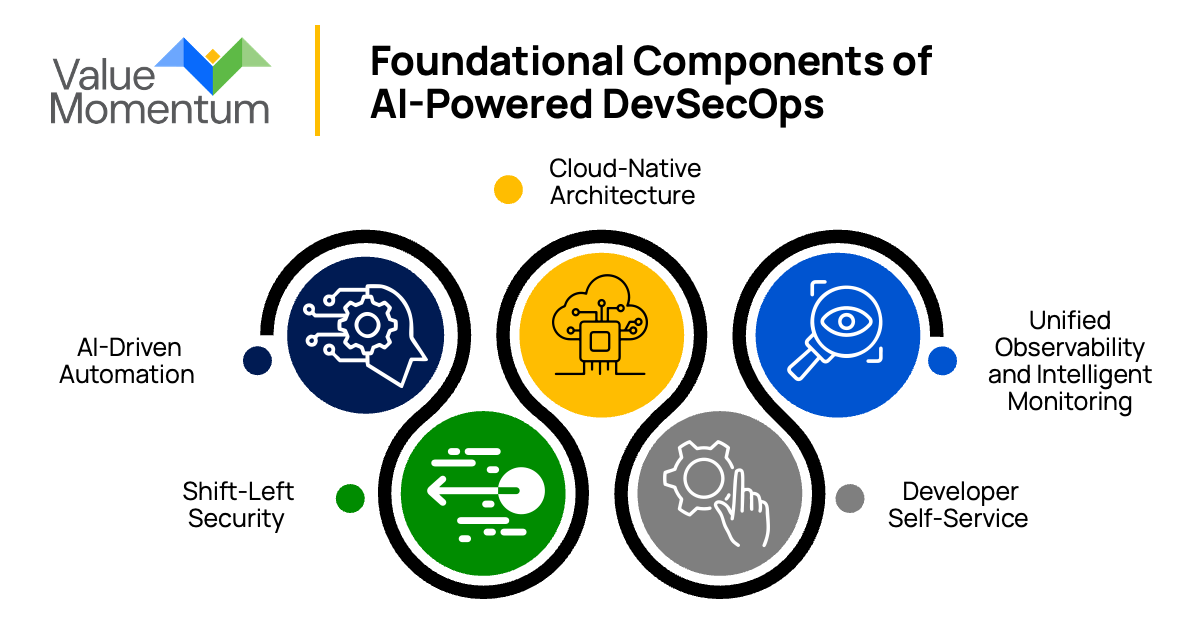
1. AI-Driven Automation
AI supports DevSecOps by automating hand-offs and decisions across the SDLC, reducing manual effort and improving delivery consistency. For example, AI-assisted code review reduces friction between development and security teams by surfacing issues early and recommending fixes before code is merged. In testing, documentation support and intelligent test selection streamline workflows while ensuring quality gates stay intact.
These patterns are widely adopted: GitLab’s 2024 Global DevSecOps Report indicates that 62% of developers now use AI tools to write or improve code, helping teams shorten iteration cycles and maintain quality at scale. In insurance environments — where releases must navigate complex integrations across claims, underwriting, and policy platforms — these efficiencies allow teams to move faster without increasing risk.
2. Shift-Left Security
Shift-left security is central to DevSecOps. By embedding security checks directly into build and deployment workflows, teams catch risks sooner and reduce downstream rework. Automated static analysis, secrets detection, and container image validation enforce policy consistently, even as teams scale across portfolios.
The case for early controls is strong: Synopsys’ 2024 Open Source Security and Risk Analysis Report found that 86% of codebases contained open-source vulnerabilities, with 81% containing high- or critical-risk issues, underscoring how easily risk enters software before deployment. Shift-left practices strengthen DevSecOps by ensuring security reviews happen continuously, rather than as a final gate before release.
3. Cloud-Native Architecture
Cloud-native engineering provides the infrastructure consistency needed for DevSecOps to succeed. By defining IaC and packaging services in containers, teams can spin up standardized environments automatically, enforce governance through policy-as-code, and eliminate configuration drift across development, testing, and production.
This foundation enables DevSecOps teams to automate provisioning, apply uniform guardrails, and integrate security controls from the start. Adoption continues to accelerate: a 2023 survey found that 76% of organizations run containers in production, demonstrating growing maturity across industries, including regulated sectors like insurance.
4. Developer Self-Service
Developer self-service enables engineers to access approved tools, environments, and deployment templates on demand. By reducing handoffs and ticket queues, teams can build, test, and release changes faster while staying aligned to organizational standards.
In a DevSecOps model, this helps ensure secure defaults are applied automatically — from identity and network policies to baseline configurations. The result is greater delivery speed with less risk, especially across large insurance portfolios where consistency and compliance are critical.
5. Unified Observability and Intelligent Monitoring
In modern DevSecOps, visibility across your entire stack is critical — from core systems to cloud environments and third-party services. Unified observability provides a consistent view of logs, metrics, traces, and business telemetry, enabling teams to detect, diagnose, and resolve issues faster. When coupled with AIOps, observability becomes proactive: Anomalies are spotted before they escalate, root causes are identified automatically, and remediation workflows can be triggered or suggested.
For insurers, this matters deeply. Hybrid architectures, distributed applications, and regulatory constraints make fragmented monitoring tools a liability. Insurers that move to a unified observability model improve operational efficiency, reduce downtime and gain insights that support pricing, fraud detection and claims handling.
As insurers accelerate digital delivery, AI-powered DevSecOps offers a pragmatic way to balance speed with security. By embedding automation, shared guardrails, and unified observability throughout the development life cycle, teams can reduce risk earlier, standardize delivery across portfolios, and shorten release cycles without compromising compliance or customer experience.
The result is a more predictable, resilient software pipeline — one that supports continuous improvement across policy, billing, claims, and analytics platforms. Over time, AI-enabled monitoring, intelligent testing, and automated remediation will become critical differentiators, helping insurers modernize faster and respond to market change with confidence.
Curious about how cloud-native engineering can help you? Read our case study, “Top Five North American Insurer Drives Customer Experience Through Microsoft Azure Cloud Migration.”