

Rising indemnity costs, increasingly sophisticated fraud, and evolving customer expectations are forcing claims organizations to reexamine long-standing workflows and operating models. Carriers of all sizes are being forced to reckon with whether their current organizational practices are equipped to provide the level of speed, accuracy, and transparency the market now demands.
Yet progress on the journey to a modern claims organization varies widely across the industry. Many insurers continue to struggle with legacy platforms, manual processes, and siloed data. With mounting competitive pressure, these gaps are harder to ignore — especially as leading carriers demonstrate what’s possible with the right mix of automation, analytics, and digital engagement.
The Key Drivers Reshaping Claims Modernization
According to our benchmarking study of 75 P&C carriers, The State of Claims Maturity in P&C Insurance 2026, pressures are converging to make claims modernization an immediate priority.
Our research highlighted five primary forces that are reshaping claims operations:
- Claims Leakage
More than 40% of carriers cited leakage as a top challenge, driven by missed subrogation opportunities, litigation costs, and fraud-related overpayments. Reducing leakage has become a critical focus area as insurers look to tighten recovery processes and identify hidden cost drivers. - Fraud Detection Gaps
Over 30% of insurers reported inaccurate fraud detection as a top concern. Fraud is also becoming more sophisticated as generative artificial intelligence (GenAI) enables attackers to automate and scale their efforts. Traditional rules-based detection models can’t keep up, leaving carriers vulnerable to increasingly complex schemes. - Rising Customer Expectations
Policyholders today expect digital-first claims experiences with faster cycle times, real-time updates, and higher transparency. While Manual workflows slow down resolution, introduce errors, and risk undermining trust. - Legacy Systems
More than 25% of insurers acknowledge that outdated claims systems are holding back their operations. Legacy platforms reduce interoperability, limit access to data, and make it difficult to deploy modern tools — particularly for mid-tier carriers facing resource constraints. - Operational Cost Pressures
Indemnity payments and loss adjustment expenses (LAE) continue to rise, tightening margins and increasing the need for greater efficiency. Over 25% of carriers cited reducing LAE as their third-highest priority. Carriers must optimize resources without compromising service quality, which is increasingly challenging without automation and predictive capabilities.
These pressures are widening the gap between carriers with modern claims operations and those still constrained by legacy systems and manual processes. Addressing them requires more than incremental improvements — it demands a strategic shift in how claims teams leverage technology, data, and standardized workflows.
How to Achieve a Modern Claims Workflow
As carriers respond to rising pressures from leakage, fraud, customer expectations, and operational cost, meaningful progress requires a coordinated set of capabilities. Mature organizations combine modern technologies with disciplined processes to improve accuracy, reduce manual effort, and deliver better customer experiences. Here are five steps to get started.
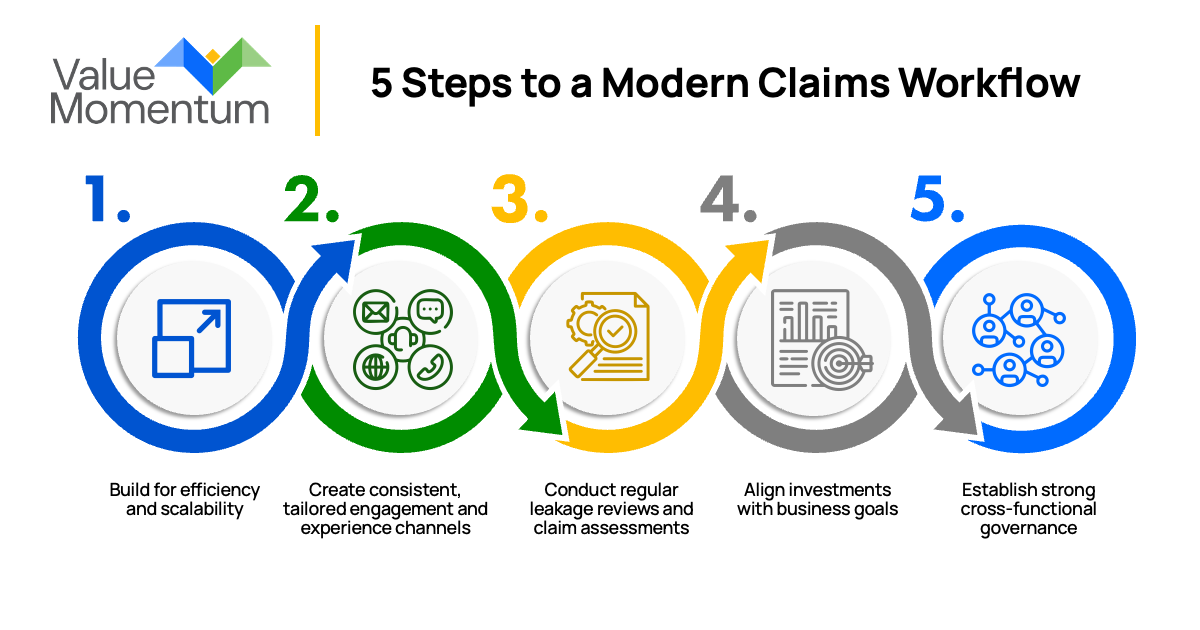
1. Build for efficiency and scalability.
Legacy systems often struggle to support the volume and complexity of data and integrations that power modern claims processing. By migrating to cloud platforms, insurers can securely store and process large data sets as well as integrate more effectively across systems. With the right foundation in place, intelligence-assisted workflows, GenAI for documentation and compliance, advanced analytics, and AI-enabled fraud detection can further reduce manual work and help adjusters make faster, more consistent decisions.
2. Create consistent, tailored engagement and experience channels.
Mobile-first first-notice-of-loss (FNOL), self-service portals, and real-time status tracking provide policyholders with transparency into their claim progress and more convenient methods to interact with their insurers. These capabilities reduce frustration and accelerate satisfaction by eliminating unnecessary manual interactions and freeing up adjusters to address complex claims or investigations. Many insurers see customer experience improvements and fewer errors as a result of digital claims tools.
3. Conduct regular leakage reviews and claim assessments.
Consistent review — especially after modernization — helps insurers identify subrogation opportunities, assess litigation exposure, and identify fraud or inefficiencies that may otherwise go unnoticed. Given that leakage now accounts for 7–14% of insurers’ total spend, these types of assessments are an important tool to control costs and improve profitability.
4. Align investments with business goals.
Benchmarking against industry peers or internal historical performance helps carriers identify where they are lagging organizationally, and activity-based costing sheds light on which processes or claim types consume the most resources. This enables insurers to target investments, whether in technology, staffing, or process redesign, where they deliver the greatest return on investment, rather than spreading resources thinly.
5. Establish strong cross-functional governance.
Claims modernization requires coordination across claims operations, IT, data science, customer experience, and senior leadership. Robust governance ensures changes are implemented thoughtfully; with accountability; and in alignment with enterprise-wide objectives such as profitability, customer retention, and operational resilience.
By following these five steps, insurers can establish the foundation required to modernize claims with intention rather than through isolated efforts. By combining advanced tools with disciplined processes, carriers can reduce leakage, improve accuracy, and deliver faster, more transparent experiences for policyholders and producers.
Charting the Path Toward Modern Claims Excellence
By focusing on strategic areas of investment and following a structured approach, insurers can enhance their claims modernization maturity levels. Building claims operations that are more efficient, data-driven, and responsive to policyholder needs not only improves short-term results, but it fosters an operational resilience that can yield long-term success.
Carriers that take a disciplined, technology-enabled approach today will be best positioned to reduce leakage, strengthen customer trust, and compete with greater confidence in 2026 and beyond.
Interested in learning more about where insurers are in their claims modernization journeys? Read the full report, The State of Claims Maturity in P&C Insurance 2026, to see where insurers fall on the maturity curve and what steps they can take to assess their current state.