

While carriers continue to expand digital capabilities for customers, agents still play a central role in acquiring, servicing, and retaining policyholders. As a result, agent experience directly impacts retention and long-term distribution strength.
J.D. Power research shows that independent agents are significantly more likely to recommend carriers with whom they have strong relationships. And as distribution becomes more digital, those relationships are increasingly shaped by everyday interactions with carrier systems and workflows.
Agent portals, the primary interface through which agents quote, bind, and manage policies, play a pivotal role in these interactions. That same J.D. Power study shows that agent satisfaction scores are hundreds of points higher when carriers, including their portals, are described as “very easy” to work with. Yet most agents say that insurers do not meet that standard.
When designed well, agent portals reduce friction and improve productivity, ultimately improving insurers’ agent Net Promoter Score. But when they fall short, it can weaken even long-standing relationships.
What Makes a Modern Agent Portal
Rather than focusing on technology upgrades, leading insurers are reframing the conversation around three foundational questions that connect agent experience directly to business performance.
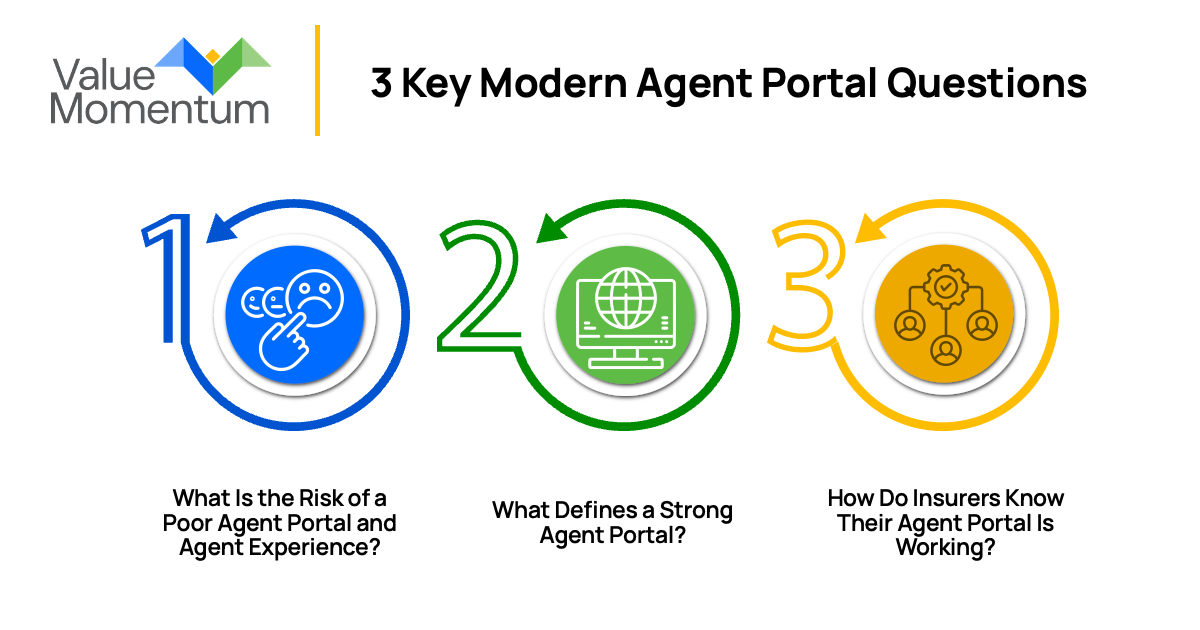
1. What Is the Risk of a Poor Agent Portal and Agent Experience?
When portals are difficult to navigate or slow routine transactions, agents are less likely to complete quotes, submit new business, or prioritize a carrier when presenting options to customers. Even small delays can reduce bind rates, increasing the risk that business is placed elsewhere. Over time, carriers with cumbersome portals risk becoming a secondary option rather than a preferred partner.
Lack of transparency compounds these challenges. When agents lack visibility into commissions, incentives, or payment status, growth opportunities become harder to identify. What begins as a technology issue ultimately becomes a distribution and revenue risk.
2. What Defines a Strong Agent Portal?
Agents need immediate visibility into what business they can write, along with simple processes for submissions, endorsements, proof of insurance, and certificates. Reducing ambiguity helps agents move quickly while avoiding unnecessary rework or declined submissions.
Minimizing friction is equally important. Straight-through processing (STP) for eligible risks, data pre-fill, and reduced rekeying allow agents to generate quotes faster and with fewer errors. Easy access to underwriting or carrier support ensures that complex cases do not stall unnecessarily. And clear explanations of rate changes, premium adjustments, and commission structures help agents manage expectations and build trust with customers.
3. How Do Insurers Know Their Agent Portal Is Working?
Measuring agent experience requires tying portal performance to clear, measurable KPIs that reflect how efficiently agents can do business and how effectively carriers operate. Insurers can evaluate agent portal success through a combination of distribution and operational performance metrics.
Key distribution performance KPIs include higher bind rates, faster quote-to-bind cycle times, and increased use of pre-submission eligibility checks. Operational efficiency KPIs include lower cost per submission, higher STP rates for standard risks, increased adoption of self-service, improved appetite guidance and hit ratios, and AI-assisted risk evaluation.
By regularly revisiting these three questions, insurers can continuously evaluate their agent portal performance and make informed decisions about how to modernize it.
Choosing the Right Path to Enhance the Agent Portal
Once insurers have evaluated their agent portal through the lens of agent experience, operational efficiency, and measurable outcomes, the focus shifts from assessment to execution.
But there is no single approach that fits every organization. Instead, insurers typically pursue one of three paths when enhancing or modernizing the agent portal, each with distinct trade-offs:
- Low-code/no-code platforms support rapid development of common agent workflows and faster time to market, particularly for standard submissions, servicing, and reporting use cases.
- Bespoke development provides full control to build highly customized digital experiences, including support for multiple form factors and mobile, but requires sustained investment in development talent and long-term maintenance.
- Native solutions leverage insurance-specific platforms, such as Guidewire Jutro Digital Platform, to accelerate delivery with pre-built functionality aligned to P&C workflows. This route may trade some flexibility for speed and scale.
When choosing among these options, insurers should evaluate each path through a consistent set of strategic considerations:
1. Business Goal Alignment
The right agent portal approach should align with the business’s plans for growth and competition. Insurers should assess how quickly new capabilities need to be delivered, the level of flexibility required, and whether the solution aligns with insurance-specific processes.
Important business goal considerations include:
- Speed of Delivery
Agile deployment models that enable rapid release of new features and enhancements help insurers respond to changing market conditions and agent expectations. - Customization and Flexibility
The ability to adapt workflows, products, and experiences to unique business requirements may influence whether a configurable platform or bespoke approach is more appropriate. - Domain Specificity
Alignment with P&C insurance processes reduces complexity, minimizes workarounds, and accelerates adoption by agents and internal teams. - Scalability and Performance
The portal must reliably support growth, seasonal volume spikes, and high traffic without degrading agent experience or operational efficiency.
- Speed of Delivery
2. Talent and Tool Availability
Organizational readiness plays a significant role in determining which modernization path is sustainable. Modernization plans need to factor in the resources and budget that are available now rather than waiting for an ideal set of tools and skill sets.
Critical talent and tool components to consider are:
- Integration Capability
Seamless integration with core policy, billing, claims, and underwriting systems is essential to deliver end-to-end workflows and avoid fragmentation. - Developer Skills and Capacity
Insurers should consider whether they have access to the talent and expertise required to build, maintain, and enhance the portal over time.
- Integration Capability
3. Long-Term Strategic Impact
Agent portal modernization decisions extend well beyond initial delivery. Like any other major initiative, agent portal investments should be evaluated through a long-term lens.
Evaluation factors for long-term impact should encompass:
- Cost of Ownership
Total cost should include ongoing maintenance, enhancements, and operational support, not just upfront implementation.
- Strategic Alignment
The chosen approach should fit within the insurer’s broader technology roadmap and business strategy. - Vendor Lock-in Risk
Insurers should assess potential dependency on a single provider and how that may affect future flexibility.
- Strategic Alignment
These choices shape not only how an agent portal is built, but how effectively it supports distribution over time. Aligning agent experience with the business strategy helps insurers position their agent portal modernization as a growth vehicle rather than a point-in-time enhancement.
Agent Portals: From Transactional Portals to Strategic Distribution Assets
Agent portals play an increasingly central role in how carriers nurture long-term agent relationships. Legacy approaches to agent experience that introduce friction or limit transparency can undermine even the most profitable insurers’ distribution strategies.
Insurers that define success clearly, align portal decisions with business and technology strategy, and modernize with intent can evolve their agent portal into a strategic asset that drives long-term growth.
To learn how other insurers are approaching agent portal modernization in practice, view our on-demand webinar, “Modern Agent Portals: Elevating Experience and Driving Profitable Growth.”